

Trivalent vs Hexavalent Chromate Conversion Coating: How to Choose the Right Aluminum Surface Treatment
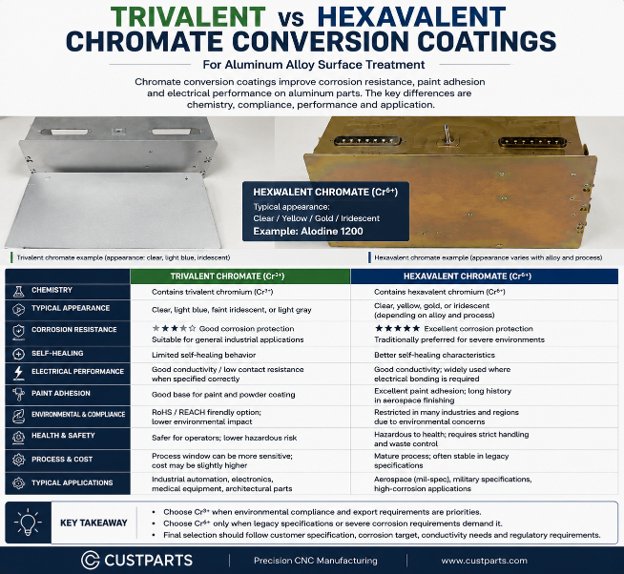
Trivalent andhexavalent chromate conversion coating comparison for aluminum CNC parts
A CNC-machined aluminum component may leavethe machine with accurate dimensions and a clean surface, yet it can still bevulnerable in service. Aluminum forms a natural oxide film, but that film isnot always sufficient for humid factories, transport, repeated handling,electrical contact, or subsequent painting. A chemical conversion coatingcreates a controlled protective layer that improves corrosion behaviour whileadding very little dimensional build-up.
For European automation and industrialequipment projects, the choice is often between a trivalent chromate conversioncoating and a legacy hexavalent chromate conversion coating. The correct answeris not determined by colour alone. It depends on the drawing, alloy, corrosiontarget, electrical requirements, coating system, and the regulations that applyto the finished product and its supply chain.
1. What Is Chromate Conversion Coating?
Chromate conversion coating is a chemicalsurface treatment for aluminum and aluminum alloys. Unlike electroplating oranodizing, it does not deposit a thick metallic layer or grow a substantialoxide layer using electrical current. After cleaning and deoxidising, thealuminum is exposed to a controlled chemical solution. Reactions at the surfaceform a thin, adherent conversion film containing aluminum and chromiumcompounds, together with other constituents specific to the process chemistry.
The film provides three practicalfunctions. First, it slows corrosion by reducing the exposure of the reactivealuminum surface. Second, it can retain useful electrical conductivity becauseit is much thinner and generally less insulating than conventional anodizing.Third, it creates a suitable base for liquid paint, primer, or powder coating.These benefits make conversion coating a common aluminum surface treatment forenclosures, brackets, plates, housings, grounding components, and paintedassemblies.
2. Trivalent Chromate Conversion Coating (Cr3+)
A trivalent chromate conversion coatinguses chromium mainly in the Cr3+ oxidation state. Modern trivalent chromiumprocesses are designed to provide corrosion protection, paint adhesion, andcontrolled electrical performance without intentionally using hexavalentchromium in the treatment chemistry. Depending on the proprietary formulation,the film may also contain zirconium, fluorides, or other compounds that supportfilm formation and corrosion resistance.
Typical appearance ranges from clear ornearly colourless to light blue, faintly iridescent, or light grey. Appearancecan vary depending on alloy, chemistry and coating thickness. Machining marks,grain structure, heat treatment, and pre-cleaning can also influence the finalvisual result. Therefore, a clear trivalent coating should be specified byprocess and performance requirements, not accepted only because it looksconsistent.
The main advantage for European industrialprojects is regulatory and environmental positioning. A qualified Cr3+ processcan support RoHS- and REACH-related supply-chain requirements because it avoidsthe intentional use of Cr6+ chemistry. However, “trivalent” is not a completecompliance certificate. Buyers should request the process declaration, safetyinformation, coating certificate, and any required test evidence. The finishedcomponent must still be assessed against the exact product scope, restricted-substancethreshold, exemptions, and customer specification.
Trivalent coatings are widely used onautomation components, industrial equipment parts, electronic housings,control-system hardware, and general CNC aluminum parts. They are particularlyattractive when parts will enter the EU market, when operator exposure andwaste treatment are priorities, or when a clear finish is preferred. Corrosionperformance and contact resistance can be very good when the selected chemistryis qualified for the alloy and the coating weight is controlled.
3. Hexavalent Chromate Conversion Coating (Cr6+)
Hexavalent chromate conversion coating isthe traditional technology associated with many aerospace, defence, and legacyindustrial specifications. It has a long performance history and is valued forstrong corrosion resistance, reliable paint adhesion, and activecorrosion-inhibiting behaviour. Cr6+ species retained in the film can migratetoward a damaged area and help suppress corrosion, which gives the coating itswell-known self-healing capability.
Its appearance is not always yellow.Depending on the aluminum alloy, bath chemistry, coating class, treatment time,and coating thickness, the surface may be clear, yellow, gold, or iridescent.Appearance can vary depending on alloy, chemistry and coating thickness. A paleor clear film should not be assumed to be trivalent, and a yellow film shouldnot be accepted as proof of a particular specification. Process certificationand, where required, analytical verification are more reliable than colour.
The technical strengths of Cr6+ come withsignificant health, environmental, and regulatory constraints. Hexavalentchromium is hazardous and requires strict controls for worker exposure,rinsing, wastewater, and waste disposal. In the EU, RoHS restricts hexavalentchromium in applicable electrical and electronic equipment, subject to definedthresholds and exemptions. Several Cr6+ substances are also subject to REACHauthorisation controls, and the regulatory position continues to evolve. ForEuropean projects, a hexavalent process should therefore be used only when thecustomer specification, approved drawing, or validated performance requirementclearly demands it and the legal route has been confirmed.
4. Trivalent vs Hexavalent Chromate Comparison
Parameter | Trivalent chromate (Cr3+) | Hexavalent chromate (Cr6+) |
Chemistry | Primarily Cr3+; proprietary systems may include zirconium or other additives | Uses Cr6+ compounds and forms a film containing chromium species |
Appearance | Clear, light blue, faint iridescent, or light grey | Clear, yellow, gold, or iridescent; depends on alloy and process |
Corrosion resistance | Good to high when qualified and tightly controlled | Excellent and historically proven in severe environments |
Self-healing | Limited compared with traditional Cr6+ films | Stronger active inhibition and self-healing behaviour |
Electrical conductivity | Good with the correct coating class and controlled film weight | Good; established for bonding and grounding applications |
Paint adhesion | Good base for primer, paint, and powder coating | Excellent adhesion with a long aerospace finishing history |
Environmental compliance | Often preferred for RoHS/REACH-oriented projects; verify the exact chemistry and declaration | Restricted in many uses; authorisation, exemptions, and customer approval may apply |
Typical applications | Automation, industrial equipment, electronics, general export parts | Legacy aerospace/defence specifications and demanding corrosion applications |
Note:Actual performance must be demonstrated against the specified alloy,pretreatment, coating class, and test method.
5. How to Select the Right Treatment for CNC AluminumParts
Start with the customer specification. Thedrawing, purchase order, or approved finish standard should define the requiredprocess, coating class, colour if relevant, and acceptance tests. If thespecification is unclear, do not substitute Cr3+ for Cr6+, or vice versa, basedonly on appearance. Ask the customer to confirm the governing standard and anyapproved process list.
Next, define the corrosion environment. Anindoor automation bracket has a different risk profile from a part exposed tocondensation, marine transport, cleaning chemicals, or outdoor service. Specifymeasurable acceptance criteria such as a salt-spray requirement, coating-weightrange, or qualified process standard. For painted parts, evaluate the completesystem - conversion coating, primer, and topcoat - rather than judging thepretreatment alone.
Electrical grounding also requiresengineering detail. Conversion coatings can support low contact resistance, butconductivity varies with chemistry, film weight, surface preparation, contactpressure, and ageing. Identify the actual grounding faces, connector locations,or EMI contact areas. If resistance is critical, state the test method andlimit on the drawing, and consider masking or dedicated contact zones where theassembly design requires them.
For exports to Europe, confirm thedestination product category and contractual substance requirements. RoHS isrelevant to many electrical and electronic products, while REACH obligationsconcern substances, uses, and supply-chain communication. A general statementsuch as “REACH compliant” is not enough for every project. The supplier shouldbe able to trace the finishing batch and provide the requested declaration orcertificate.
Finally, review appearance in the correctway. Colour variation may be acceptable while performance remains compliant,especially across 6061, 6082, and 7075 alloys or between machined andnon-machined surfaces. If a uniform decorative appearance is essential, definean agreed visual range or approve a sample. Chromate conversion coating isprimarily a functional finish; anodizing or painting may be more suitable whencolour consistency and wear resistance dominate.
6. CUSTPARTS Capability for Machined and Finished AluminumParts
CUSTPARTS supports aluminum components fromprototype to low-volume production, combining machining planning withsurface-finishing control. Typical materials include aluminum 6061, 6082, and7075, selected according to strength, machinability, corrosion behaviour, andcustomer specification. Parts can be produced using 3-axis and 5-axis CNCmachining for brackets, housings, plates, precision interfaces, and complexmulti-face components.
Our finishing workflow can include chemicalconversion coating, anodizing, and managed external surface treatments. Beforerelease, we review critical dimensions, masking needs, threaded features,electrical contact surfaces, cosmetic zones, and the risk of handling marks orstaining. Inspection can include CMM verification for specified geometries,together with dimensional records and finishing documentation required by theorder.
Conclusion
Choosing between trivalent and hexavalentchromate conversion coating requires more than comparing colours. Trivalentsystems are usually the practical first choice for modern European automation,electronics, and industrial equipment projects because they can providecorrosion protection, conductivity, paint adhesion, and a more favourablecompliance profile. Hexavalent systems remain technically relevant where alegacy specification or severe corrosion requirement explicitly calls for theirestablished performance and self-healing behaviour.
The final decision should follow thecustomer specification, alloy, service environment, electrical needs,coating-system design, and applicable regulations. When these requirements aredefined before machining and finishing, CNC aluminum parts can be supplied witha surface treatment that is technically correct, traceable, and suitable forthe intended market.
Website Publishing Details
Publishing field | Recommended content |
SEO title | Trivalent vs Hexavalent Chromate Coating for Aluminum CNC Parts |
Meta description | Compare trivalent and hexavalent chromate conversion coatings for aluminum CNC parts, including corrosion, conductivity, compliance, appearance and applications. |
URL slug | trivalent-vs-hexavalent-chromate-conversion-coating |
Image ALT text | Trivalent and hexavalent chromate conversion coating comparison for aluminum CNC parts |
Target keywords | trivalent chromate conversion coating; hexavalent chromate conversion coating; aluminum surface treatment; CNC aluminum parts |
Article word count | 1460 |
Recommended Internal Links
Recommended position | Target page | Suggested anchor text |
Introduction or first section | aluminum CNC machining service page | Anchor: aluminum CNC machining |
Section 1: coating functions | surface finishing / chemical conversion coating page | Anchor: aluminum surface treatment |
Section 5: decorative vs functional finish | anodizing service page | Anchor: aluminum anodizing |
Section 6: machining capability | 5-axis CNC machining page | Anchor: 5-axis CNC machining |
Section 6: inspection | quality control / CMM inspection page | Anchor: CMM inspection |
After conclusion | RFQ / contact page | Anchor: request a quote for CNC aluminum parts |
Publishing note: verify the exact live CUSTPARTS URLs beforeinserting these links.