

Black Oxide vs QPQ for CNC Machined Steel Parts: Key Differences and How to Choose
Meta Description: Compare black oxide vs QPQ treatment for CNC machined steel parts. Learn the differences in hardness, wear resistance, corrosion protection, cost, tolerances, and applications.
Introduction
Black oxide and QPQ are two common surface treatments for CNC machined steel parts. Although both processes can produce a dark or black surface appearance, they serve very different engineering purposes.
Black oxide is primarily selected for appearance, light corrosion protection, low dimensional impact, and cost-effective finishing.
QPQ treatment, also known as Quench-Polish-Quench, is a functional thermochemical treatment designed to improve surface hardness, wear resistance, fatigue strength, corrosion resistance, and service life.
Choosing the wrong surface treatment can lead to premature wear, insufficient corrosion protection, unnecessary manufacturing costs, or dimensional problems.
For engineers and product designers, the correct choice depends on several factors:
Steel grade
Surface hardness requirements
Wear conditions
Corrosion resistance requirements
Dimensional tolerances
Surface finish requirements
Production cost
Final application
This guide compares black oxide vs QPQ treatment and explains how to select the right surface treatment for precision CNC machined steel parts.
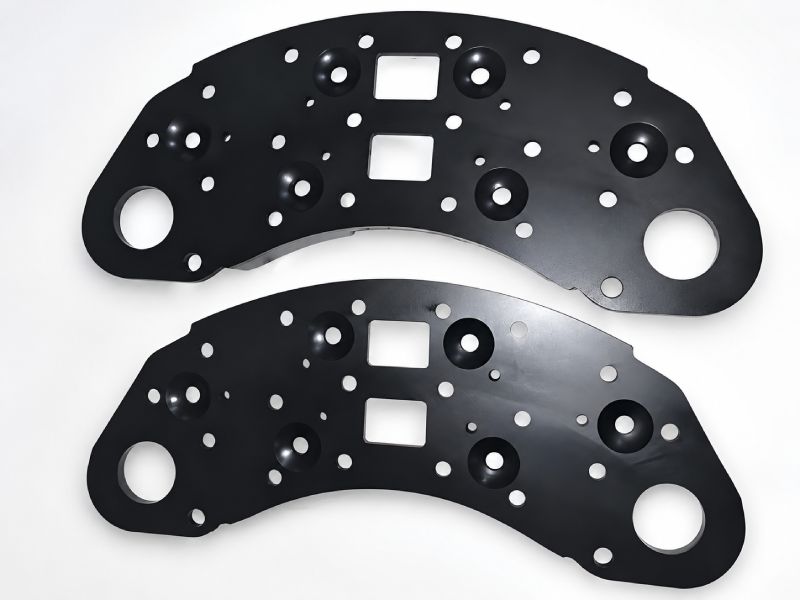
1. What Is Black Oxide Treatment?
Black oxide is a chemical conversion treatment commonly applied to carbon steel, alloy steel, tool steel, and certain cast iron components.
Unlike paint, plating, or other coatings, black oxide does not create a thick layer on the surface of the part. Instead, it chemically converts the steel surface into a dark oxide layer.
This characteristic makes black oxide particularly suitable for precision CNC machined parts where dimensional changes must be minimized.
Main Benefits of Black Oxide
Black oxide treatment can provide:
Black or dark surface appearance
Light corrosion protection
Minimal dimensional impact
Reduced light reflection
Cost-effective surface finishing
Improved appearance compared with raw machined steel
Better oil retention
Black oxide is often followed by oiling, waxing, or sealing to improve corrosion resistance.
Typical Applications
Black oxide is commonly used for:
Steel brackets
Machine blocks
Fixture components
Spacers
Shafts
Fasteners
Tooling components
Automation equipment parts
Industrial machine components
However, black oxide does not significantly increase surface hardness or wear resistance.
For components exposed to friction, sliding, rotation, or repeated mechanical contact, QPQ treatment may be a better solution.
2. What Is QPQ Treatment?
QPQ stands for Quench-Polish-Quench.
It is a thermochemical surface treatment based on salt bath nitriding followed by polishing and oxidation.
The process creates a hardened surface layer that can significantly improve the functional performance of steel components.
Main Benefits of QPQ Treatment
QPQ can improve:
Surface hardness
Wear resistance
Fatigue strength
Corrosion resistance
Sliding performance
Anti-seizure performance
Component service life
Unlike black oxide, QPQ is primarily selected for engineering performance rather than appearance.
Typical QPQ Applications
QPQ treatment is commonly used for:
Shafts
Pins
Bushings
Guide components
Sliding components
Hydraulic parts
Pneumatic components
Gears
Fixture locating components
Mold components
Robotic mechanical components
Automation equipment parts
Parts that experience friction, sliding, rotation, or repeated mechanical contact can often benefit from QPQ treatment.
3. Black Oxide vs QPQ: Quick Comparison
| Property | Black Oxide | QPQ Treatment |
|---|---|---|
| Main Purpose | Appearance and light corrosion protection | Wear resistance and surface performance |
| Surface Hardness | Little improvement | Significant improvement |
| Wear Resistance | Low | High |
| Corrosion Resistance | Light protection | Better corrosion resistance |
| Fatigue Strength | Little improvement | Can improve fatigue performance |
| Dimensional Impact | Very low | Relatively low but must be controlled |
| Surface Appearance | Black or dark | Dark grey to black |
| Cost | Lower | Higher |
| Typical Applications | Brackets, blocks, fixtures, spacers | Shafts, pins, bushings, sliding parts |
| Best For | General industrial components | Functional and wear-resistant components |
The fundamental difference is simple:
Black oxide is primarily a cosmetic and protective finish. QPQ is primarily a functional surface treatment.
4. Which Materials Are Suitable for Black Oxide?
Black oxide is commonly applied to ferrous materials.
Suitable materials may include:
Carbon steel
Medium carbon steel
C45 / 45# steel
Q235 steel
Q345 steel
40Cr steel
42CrMo / 42CrMo4 steel
Tool steel
D2 / SKD11 / 1.2379 steel
Certain cast iron materials
The final surface appearance can vary depending on:
Material composition
Heat treatment condition
Surface preparation
Machining marks
Black oxide process parameters
Final sealing method
Black oxide is not normally used for aluminum, copper, brass, zinc alloys, or engineering plastics.
Aluminum components typically use anodizing or hard anodizing.
Stainless steel requires specialized blackening processes rather than conventional carbon steel black oxide treatment.
5. Which Materials Are Suitable for QPQ Treatment?
QPQ is primarily used for ferrous materials.
Common materials include:
C45 / 45# steel
40Cr steel
42CrMo / 42CrMo4 steel
38CrMoAl steel
Alloy structural steel
Tool steel
Mold steel
Nitriding steel
Certain cast iron materials
Selected stainless steel grades
The suitability of a material for QPQ treatment should be evaluated according to its chemical composition, mechanical properties, heat treatment condition, dimensional requirements, and final application.
QPQ is generally not suitable for:
Aluminum
Copper
Brass
Zinc alloys
Engineering plastics
For precision CNC parts, material selection and QPQ process requirements should ideally be reviewed during the DFM stage.
6. Can Stainless Steel Be Black Oxided or QPQ Treated?
Stainless steel requires special consideration.
Conventional black oxide processes used for carbon steel are generally not suitable for standard stainless steel components.
Depending on the application, common surface treatments for stainless steel CNC parts include:
Passivation
Electropolishing
Bead blasting
Mechanical polishing
Black PVD coating
Specialized stainless steel blackening
QPQ may be applied to selected stainless steel grades, but the process must be carefully evaluated.
Treatment can affect:
Surface characteristics
Corrosion behavior
Appearance
Dimensional condition
For stainless steel components used in medical equipment, food processing, marine environments, or chemical applications, alternative treatments such as passivation or electropolishing may be more appropriate.
The surface treatment should always be selected according to the actual working environment rather than appearance alone.
7. Black Oxide vs QPQ Corrosion Resistance
Black oxide provides relatively light corrosion protection.
Its corrosion resistance usually depends heavily on additional sealing methods such as:
Oil
Wax
Protective coatings
For this reason, black oxide is commonly used for parts operating in dry indoor environments.
Typical applications include:
Fixtures
Tools
Machine components
Equipment brackets
General industrial parts
QPQ typically provides better corrosion resistance than conventional black oxide because of the nitriding and oxidation process.
However, QPQ should not automatically be considered a replacement for corrosion-resistant materials.
For components operating in marine, chemical, high-humidity, or highly corrosive environments, engineers should evaluate both material selection and surface treatment requirements.
8. Black Oxide vs QPQ Wear Resistance
Wear resistance is one of the most important differences between black oxide and QPQ treatment.
Black oxide does not significantly improve the surface hardness of a steel component.
Therefore, it is generally not the best choice for parts exposed to:
Sliding
Rotation
Friction
Repeated contact
High mechanical wear
QPQ treatment creates a hardened surface layer and can significantly improve wear resistance.
It is commonly selected for:
Sliding shafts
Locating pins
Bushings
Guide components
Hydraulic parts
Pneumatic components
Moving mechanical parts
Robotic mechanical components
If wear resistance is a critical functional requirement, QPQ is generally a better option than black oxide.
9. Does QPQ Affect CNC Machining Tolerances?
This is an important consideration for precision CNC machined parts.
Black oxide normally has very little dimensional impact because it does not add a thick coating layer.
This makes it suitable for components with tight dimensional tolerances.
QPQ also has relatively low dimensional impact compared with many conventional coatings.
However, QPQ is a thermochemical treatment.
For precision components, engineers should consider potential dimensional changes and distortion, particularly for:
Thin-wall components
Long shafts
Precision holes
Close-fitting surfaces
Large flat components
Components with strict straightness requirements
Before QPQ treatment, the engineering team should review:
Final hardness requirements
Critical dimensions
Hole tolerances
Shaft diameters
Threaded areas
Flatness
Straightness
Surface roughness
Grinding requirements
Final inspection requirements
For high-precision CNC components, the drawing should clearly specify whether tolerances apply before or after QPQ treatment.
10. Should QPQ Be Applied Before or After CNC Machining?
In most applications, the main CNC machining operations are completed before QPQ treatment.
A typical manufacturing process may include:
Material Preparation → CNC Machining → Inspection → QPQ Treatment → Final Inspection
However, the correct process sequence depends on:
Part geometry
Material grade
Required surface hardness
Dimensional tolerances
Surface roughness requirements
Grinding requirements
Functional surfaces
Some precision components may require additional grinding, polishing, or finishing operations.
For this reason, QPQ requirements should be considered before CNC machining begins.
A professional CNC machining supplier should review the drawing and surface treatment requirements during the DFM process.
11. Black Oxide vs QPQ Surface Appearance
Black oxide typically produces a black or dark surface.
The final appearance may vary depending on:
Steel grade
Surface preparation
Machining marks
Surface roughness
Treatment parameters
Final oil sealing
QPQ typically produces a dark grey to black surface.
However, QPQ should not primarily be selected as a decorative finish.
If the only requirement is a black appearance, black oxide may be sufficient.
If the component requires both a dark surface and improved wear resistance, QPQ may be the better option.
For cosmetic components, surface appearance samples should be approved before mass production.
12. Black Oxide vs QPQ Cost
Black oxide is generally less expensive than QPQ treatment.
It is suitable for:
Cost-sensitive industrial parts
General machine components
Steel brackets
Fixture parts
Spacers
Components requiring a simple black finish
QPQ costs more because it is a more complex functional treatment.
However, the lowest initial processing cost does not always result in the lowest total cost.
For wear-resistant mechanical components, QPQ may provide longer service life and reduce replacement frequency.
The correct question is therefore not simply:
Which treatment is cheaper?
Instead, engineers should ask:
Which treatment provides the required performance at the lowest total manufacturing and operating cost?
13. Which Treatment Is Better for Precision CNC Machined Parts?
There is no universal answer.
The correct treatment depends on the functional requirements of the component.
Choose Black Oxide When:
The part requires a black appearance
Light corrosion protection is sufficient
Cost control is important
Dimensional change must be minimized
The component operates in a dry indoor environment
High wear resistance is not required
The part is a bracket, block, spacer, fixture, or general machine component
Choose QPQ When:
High wear resistance is required
Higher surface hardness is needed
The part experiences sliding or friction
Repeated mechanical contact occurs
Improved fatigue performance is required
Longer service life is important
The part is a shaft, pin, bushing, guide, hydraulic component, or moving mechanical component
14. Black Oxide vs QPQ for Robotics and Automation Components
Robotics and industrial automation systems often contain both static structural components and moving mechanical components.
The correct surface treatment depends on the function of each part.
Black oxide may be suitable for:
Robot mounting brackets
Sensor brackets
Equipment frames
Fixture blocks
Structural steel components
Machine bases
Spacers
QPQ may be more suitable for:
Robotic shafts
Locating pins
Guide components
Sliding mechanisms
Wear-resistant bushings
Pneumatic components
Hydraulic components
Repeated-contact mechanical parts
For robotics and automation equipment, surface treatment selection should consider the complete operating environment, including load, friction, movement frequency, required service life, and maintenance conditions.
15. Common Mistakes When Choosing Black Oxide or QPQ
Mistake 1: Choosing QPQ Only Because It Has Better Performance
Better technical performance does not automatically mean it is the correct manufacturing choice.
If the component does not experience wear, friction, or repeated mechanical contact, QPQ may add unnecessary cost.
Mistake 2: Using Black Oxide for High-Wear Components
Black oxide does not significantly improve surface hardness.
Using it on shafts, pins, sliding components, or other high-wear parts may lead to premature surface failure.
Mistake 3: Ignoring Tolerances Before Surface Treatment
Critical dimensions should be reviewed before QPQ treatment.
The drawing should clearly define whether final tolerances apply before or after treatment.
Mistake 4: Selecting Surface Treatment Based Only on Appearance
Two treatments may produce similar colors but provide completely different mechanical performance.
Surface treatment should be selected according to functional requirements.
Mistake 5: Ignoring the Base Material
Not every material responds to black oxide or QPQ treatment in the same way.
Material grade, heat treatment condition, hardness, geometry, and working environment should be evaluated together.
16. Frequently Asked Questions
Is QPQ Better Than Black Oxide?
QPQ provides better surface hardness, wear resistance, fatigue performance, and corrosion resistance.
However, black oxide is more economical and may be sufficient for components that only require a black appearance and light corrosion protection.
Does Black Oxide Increase Surface Hardness?
No. Black oxide does not significantly increase the surface hardness of steel components.
Does QPQ Improve Wear Resistance?
Yes. Improving wear resistance is one of the primary reasons engineers specify QPQ treatment.
Is QPQ Suitable for Precision CNC Parts?
Yes, but dimensional tolerances, distortion risk, surface roughness, and final inspection requirements should be evaluated before treatment.
Can Aluminum Parts Be QPQ Treated?
No. QPQ is primarily used for ferrous materials.
Aluminum components typically use anodizing, hard anodizing, chemical conversion coating, or other suitable surface treatments.
Which Treatment Is Better for Robotic Components?
It depends on the function of the component.
Structural brackets, blocks, and static components may use black oxide.
Shafts, pins, guides, sliding components, and wear-resistant mechanical parts may benefit from QPQ treatment.
Conclusion
Black oxide and QPQ are both widely used surface treatments for CNC machined steel parts, but they solve different engineering problems.
Black oxide is a cost-effective solution for components requiring:
Black appearance
Light corrosion protection
Minimal dimensional impact
Lower processing cost
QPQ is a functional treatment for components requiring:
Higher surface hardness
Improved wear resistance
Better fatigue performance
Improved corrosion resistance
Longer service life
For general steel brackets, machine blocks, spacers, and fixture components, black oxide is often sufficient.
For shafts, pins, bushings, sliding parts, guide components, hydraulic parts, robotic components, and other wear-resistant mechanical parts, QPQ may be the better choice.
The correct surface treatment should be selected according to the material grade, part geometry, dimensional tolerances, surface hardness requirements, wear conditions, working environment, and production cost.
If you need CNC machined steel parts for robotics, automation equipment, or precision mechanical applications, send us your 2D drawings, 3D models, material specifications, tolerance requirements, and surface treatment requirements.
Our engineering team can review your project and provide DFM recommendations, material selection support, CNC machining solutions, and suitable surface treatment options before production.