

Stainless Steel CNC Machining Case Study: Precision Mechanical Part
Introduction
Stainless steel is widely used for precision mechanical parts because of its excellent strength, corrosion resistance, wear resistance, and long-term durability.
However, stainless steel CNC machining is generally more challenging than machining aluminum and many other common engineering materials.
During the machining process, manufacturers must carefully control:
Cutting forces
Heat accumulation
Tool wear
Work hardening
Vibration
Part deformation
Surface finish
Dimensional accuracy
These challenges become even more significant when the component includes deep cavities, narrow slots, small holes, tight tolerances, complex profiles, or multiple precision features.
In this stainless steel CNC machining case study, we examine the manufacturing process of a precision mechanical part and explain how machining strategy, fixture design, tool selection, and quality inspection were used to achieve stable dimensional accuracy and consistent part quality.
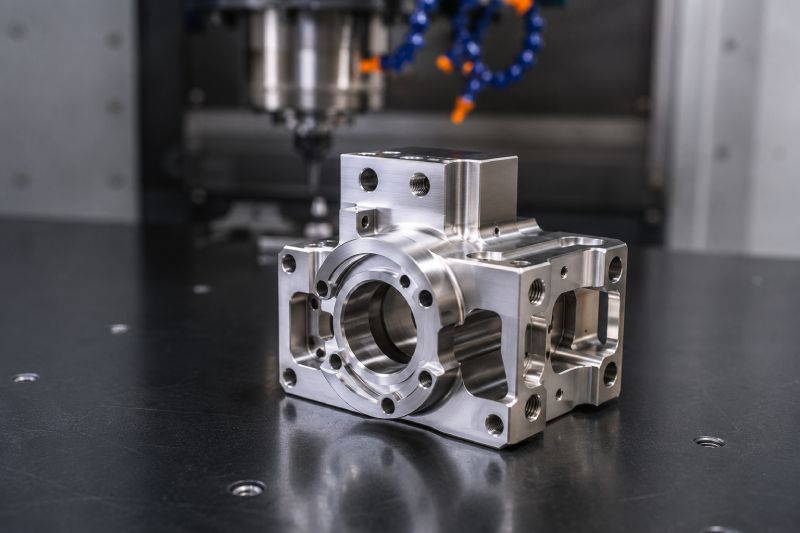
1. Project Overview
The customer required a precision mechanical component manufactured from stainless steel.
The part was designed for use in mechanical equipment where dimensional stability, corrosion resistance, and long-term reliability were important.
Part Requirements
The main project requirements included:
Material: Stainless steel
Manufacturing process: CNC milling
Part type: Precision mechanical component
Complex internal and external features
Multiple holes and precision surfaces
Tight dimensional tolerances
Controlled surface finish
Stable batch production quality
At first glance, the component appeared to be a conventional CNC machined part.
However, after reviewing the 3D model and technical drawing, our engineering team identified several manufacturing challenges.
The combination of stainless steel material properties, complex geometry, and precision requirements meant that the machining process needed to be carefully planned before production.
2. Main Challenges in Stainless Steel CNC Machining
Compared with aluminum, stainless steel is generally more difficult to machine.
Several characteristics of stainless steel can directly affect CNC machining performance.
High Cutting Forces
Stainless steel requires higher cutting forces than many aluminum alloys.
Higher cutting forces can cause:
Tool deflection
Part vibration
Reduced dimensional accuracy
Poor surface finish
Increased tool wear
This becomes particularly important when machining thin features, deep cavities, or areas requiring long cutting tools.
Heat Accumulation
Stainless steel has relatively low thermal conductivity.
During machining, heat is concentrated around the cutting tool and cutting zone instead of being quickly transferred away through the material.
Excessive heat may result in:
Faster tool wear
Dimensional instability
Poor surface quality
Reduced tool life
Proper cutting parameters and coolant application are therefore essential.
Work Hardening
Some stainless steel grades can become harder during machining.
If the cutting tool rubs against the material instead of maintaining a stable cutting action, the machined surface may work-harden.
This can make subsequent machining operations more difficult and increase tool wear.
Tool Wear
Because of the material strength and cutting characteristics of stainless steel, tool wear must be carefully controlled.
A worn cutting tool can cause:
Dimensional deviation
Increased surface roughness
Burr formation
Poor edge quality
Inconsistent batch production
For precision stainless steel CNC parts, tool condition must be monitored throughout the production process.
3. DFM Analysis Before Machining
Before production began, our engineering team performed a Design for Manufacturability analysis.
The purpose of DFM analysis was to identify potential manufacturing risks before CNC programming and machining.
The engineering review focused on:
Part geometry
Machining accessibility
Tool length requirements
Internal corner radii
Hole depth
Tolerance requirements
Datum selection
Fixture design
Inspection methods
This stage is critical for precision CNC machining.
Many production problems can be prevented before machining begins if potential risks are identified during the DFM stage.
For this stainless steel component, the machining sequence and fixture strategy were particularly important because several precision features had positional relationships with each other.
4. Machining Strategy for the Stainless Steel Part
A stable machining process requires more than simply importing a 3D model into CAM software and generating toolpaths.
The complete machining sequence must consider material behavior, cutting forces, tool accessibility, and dimensional stability.
Our machining process was divided into several stages.
Step 1: Material Preparation
The stainless steel raw material was prepared with sufficient machining allowance.
Proper material preparation helps ensure:
Stable clamping
Sufficient finishing allowance
Reliable datum creation
Consistent machining conditions
The material dimensions were checked before CNC machining began.
Step 2: Rough Machining
The first stage focused on removing most of the excess material.
The objectives of rough machining were:
Efficient material removal
Controlled cutting forces
Stable chip evacuation
Reduced heat accumulation
Sufficient allowance for finishing
Instead of machining directly to final dimensions, material was intentionally left on critical surfaces.
This finishing allowance provided better control over final dimensional accuracy.
Step 3: Semi-Finishing
After rough machining, semi-finishing operations were performed.
This stage helped create more uniform material conditions before final finishing.
Semi-finishing is particularly useful for precision stainless steel parts because it can reduce the effect of uneven residual material on the final machining process.
Step 4: Precision Finishing
Critical surfaces and dimensional features were finished using optimized machining parameters.
During this stage, we carefully controlled:
Tool selection
Spindle speed
Feed rate
Depth of cut
Tool engagement
Coolant delivery
The objective was to achieve the required dimensional accuracy while maintaining stable surface quality.
5. Tool Selection for Stainless Steel CNC Machining
Tool selection plays an important role in stainless steel machining.
Using an unsuitable cutting tool can quickly lead to excessive wear, vibration, and dimensional instability.
For this project, cutting tools were selected according to:
Material characteristics
Machining depth
Feature geometry
Surface finish requirements
Tool rigidity
Machining accessibility
Short and rigid cutting tools were used whenever possible.
Long tool overhang was minimized because excessive tool length can increase vibration and tool deflection.
For deep or difficult-to-access features, machining parameters were adjusted to reduce cutting forces and maintain process stability.
6. Fixture Design and Workpiece Stability
Fixture design is another critical factor in precision stainless steel CNC machining.
The workpiece must be securely clamped while avoiding excessive clamping forces that could cause deformation.
The fixture strategy for this project focused on:
Stable workpiece positioning
Repeatable datum control
Sufficient machining accessibility
Reduced vibration
Controlled clamping force
The machining sequence was also designed to reduce unnecessary repositioning.
Every additional setup can introduce new positioning errors.
By optimizing the fixture and setup strategy, we improved the positional consistency between different machined features.
7. Controlling Heat During Machining
Heat management was one of the key considerations during the machining process.
Because stainless steel does not dissipate heat as quickly as aluminum, excessive cutting temperature can negatively affect both the cutting tool and the workpiece.
To control machining temperature, we optimized:
Cutting speed
Feed rate
Depth of cut
Coolant application
Toolpath strategy
Stable coolant delivery helped remove heat and chips from the cutting zone.
Proper chip evacuation was also important because recutting stainless steel chips can damage the tool and reduce surface quality.
8. Achieving Tight Tolerances
Achieving tight tolerances requires control of the entire manufacturing process.
Machine accuracy alone is not enough.
For this stainless steel precision mechanical part, dimensional accuracy depended on several factors working together:
Machine condition
Tool rigidity
Tool wear control
Fixture stability
Cutting parameters
Temperature control
Machining sequence
Inspection capability
Critical dimensions were not machined directly to final size during roughing.
Instead, sufficient material allowance was retained for precision finishing.
This strategy helped reduce the influence of cutting stress and tool wear on final dimensional accuracy.
9. Surface Finish Control
Surface finish is another important quality requirement for precision mechanical parts.
Poor machining conditions may cause:
Tool marks
Vibration lines
Scratches
Burrs
Uneven surface texture
To improve surface quality, we optimized the finishing toolpaths and cutting parameters.
The engineering team also monitored tool condition during machining.
Using a worn cutting tool for final finishing can significantly reduce surface quality and dimensional consistency.
After CNC machining, the component was carefully deburred and cleaned before final inspection.
10. Quality Inspection Process
Precision CNC machining requires reliable inspection methods.
After machining, the stainless steel component underwent dimensional and visual inspection.
Depending on the feature and tolerance requirements, inspection equipment may include:
Calipers
Micrometers
Height gauges
Pin gauges
Thread gauges
Surface roughness testers
Coordinate Measuring Machines (CMM)
Critical dimensions and geometric relationships were carefully inspected.
The quality control process focused on verifying:
Dimensional accuracy
Hole positions
Feature relationships
Surface quality
Burr removal
Overall part appearance
Inspection results were recorded according to the project quality requirements.
11. Final Machining Results
After optimizing the machining process, the stainless steel precision mechanical part was successfully manufactured according to the project requirements.
The final results included:
Stable dimensional accuracy
Controlled surface finish
Accurate hole positions
Clean machined edges
Reduced tool marks
Consistent part quality
The successful completion of the project demonstrated the importance of combining engineering analysis, CNC programming, machining experience, and quality inspection.
Precision stainless steel machining is not achieved through a single manufacturing factor.
It requires control of the complete production process.
12. Key Lessons from This Stainless Steel CNC Machining Case Study
This project highlights several important principles for machining precision stainless steel components.
1. DFM Analysis Should Be Performed Before Production
Potential machining risks should be identified before CNC programming begins.
2. Tool Rigidity Is Critical
Shorter and more rigid cutting tools generally provide better machining stability.
3. Heat Must Be Carefully Controlled
Proper cutting parameters and coolant application help reduce excessive heat accumulation.
4. Roughing and Finishing Should Be Separated
Leaving sufficient finishing allowance improves dimensional control.
5. Fixture Design Affects Accuracy
Stable and repeatable workpiece positioning is essential for precision machining.
6. Tool Wear Must Be Monitored
Tool condition directly affects dimensional accuracy and surface quality.
7. Inspection Must Match the Tolerance Requirements
Different features require different inspection methods and equipment.
13. Applications of Precision Stainless Steel CNC Parts
Precision stainless steel CNC machined components are widely used in industries such as:
Industrial automation
Robotics
Medical equipment
Semiconductor equipment
Packaging machinery
Food processing equipment
Aerospace systems
Precision instruments
Mechanical assemblies
Custom machinery
The combination of corrosion resistance, mechanical strength, and dimensional stability makes stainless steel suitable for demanding engineering applications.
14. How to Reduce the Cost of Stainless Steel CNC Machining
Although stainless steel CNC machining is generally more expensive than aluminum machining, proper design optimization can help reduce production costs.
Engineers should consider the following recommendations:
Avoid unnecessary tight tolerances
Reduce excessive machining depth
Use reasonable internal corner radii
Avoid unnecessarily thin walls
Standardize hole and thread sizes
Minimize the number of machining setups
Clearly define critical dimensions
Specify surface finish only where necessary
A professional CNC machining supplier can provide DFM feedback before production to identify opportunities for reducing machining time and manufacturing cost.
Conclusion
Stainless steel CNC machining requires careful control of cutting forces, heat accumulation, tool wear, fixture stability, machining sequence, and dimensional inspection.
In this precision mechanical part case study, successful production depended on a complete manufacturing strategy that included:
DFM analysis
Stable fixture design
Optimized roughing and finishing operations
Proper cutting tool selection
Controlled machining parameters
Tool wear monitoring
Precision quality inspection
For complex stainless steel CNC parts, the best results are achieved when part design, machining strategy, and inspection requirements are evaluated together before production begins.
If your project requires custom stainless steel CNC machining, precision mechanical components, prototypes, or low-volume production, working with an experienced CNC machining supplier can help reduce manufacturing risks and achieve more stable part quality.
Frequently Asked Questions
Is stainless steel difficult to CNC machine?
Yes. Compared with aluminum and many other common materials, stainless steel typically requires higher cutting forces and more careful control of heat, tool wear, and cutting parameters.
What stainless steel grades are commonly used for CNC machining?
Common stainless steel grades for CNC machining include 303, 304, 316, 416, and 17-4 PH. The appropriate material depends on corrosion resistance, mechanical strength, machinability, heat treatment, and application requirements.
How can deformation be reduced during stainless steel machining?
Deformation can be reduced through proper fixture design, balanced material removal, optimized machining sequences, controlled cutting forces, and sufficient finishing allowance.
How can the surface finish of stainless steel CNC parts be improved?
Surface finish can be improved by using sharp cutting tools, stable fixtures, appropriate cutting parameters, optimized finishing toolpaths, effective coolant delivery, and proper tool wear control.
Why is DFM important for stainless steel CNC machining?
DFM analysis helps identify potential problems related to part geometry, tool accessibility, tolerances, fixtures, and inspection before production begins. This can reduce machining risks, production costs, and delivery delays.