

3 Axis vs 4 Axis vs 5 Axis CNC Machining: How to Choose the Right Machining Strategy
Choosing between 3-axis, 4-axis, and 5-axis CNC machining is not simply a matter of selecting the most advanced machine.
The right machining strategy depends on part geometry, feature accessibility, dimensional tolerances, surface finish requirements, setup quantity, production volume, and total manufacturing cost.
A relatively simple component may be more economical to produce on a 3-axis CNC machine. A part with features on multiple sides may benefit from 4-axis machining, while complex geometries, deep cavities, compound angles, and tight positional relationships may require 5-axis machining.
However, more axes do not always mean better results.
In some cases, using a 5-axis CNC machine for a simple part only increases machine cost without providing meaningful manufacturing benefits. In other cases, producing a complex component with 3-axis machining may require multiple setups, custom fixtures, longer lead times, and additional inspection, making 5-axis machining the more cost-effective solution.
This guide compares 3-axis vs 4-axis vs 5-axis CNC machining and explains how axis selection affects part design, accuracy, surface finish, setup time, machining cost, and production efficiency.
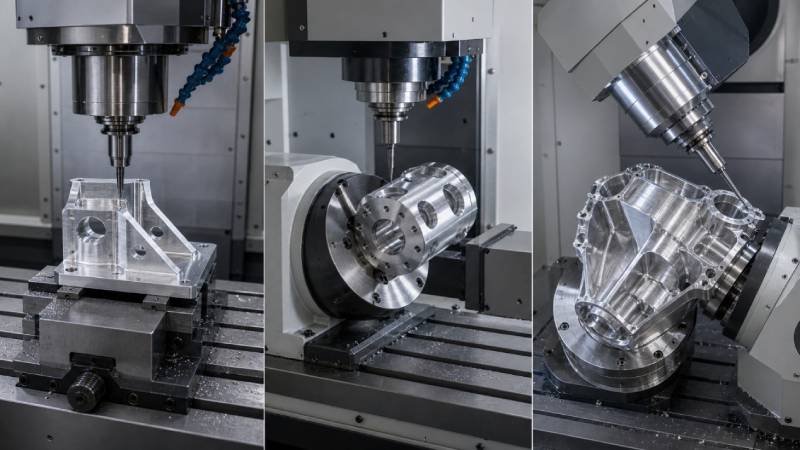
What Do Axes Mean in CNC Machining?
In CNC machining, an axis refers to a direction of machine movement.
The three basic linear axes are:
X-axis: left and right movement
Y-axis: forward and backward movement
Z-axis: up and down movement
More advanced CNC machines add rotary axes.
Common rotary axes include:
A-axis: rotation around the X-axis
B-axis: rotation around the Y-axis
C-axis: rotation around the Z-axis
The number of available axes determines how the cutting tool and workpiece can move relative to each other.
However, machine capability should not be evaluated by axis count alone.
The final machining result also depends on:
Machine rigidity
Spindle performance
Tooling
Workholding
CNC programming
Cutting parameters
Material properties
Thermal stability
Inspection capability
This is why a well-planned 3-axis machining process can sometimes produce better results than a poorly planned 5-axis process.
What Is 3-Axis CNC Machining?
A standard 3-axis CNC machine operates along three linear axes:
X
Y
Z
The cutting tool moves horizontally and vertically relative to the workpiece.
In a typical 3-axis milling process, the workpiece remains fixed in one orientation during each machining operation.
3-axis CNC machining is one of the most widely used manufacturing methods for producing precision mechanical components.
Advantages of 3-Axis CNC Machining
The main advantages include:
Lower machine rates
Wide machine availability
Relatively simple CNC programming
Lower setup complexity for simple parts
Suitable for many standard mechanical components
Cost-effective for high-volume production of suitable geometries
Typical 3-axis CNC machined parts include:
Plates
Brackets
Covers
Housings
Heat sinks
Simple pockets
Mounting components
Flat mechanical parts
For components with accessible features and relatively simple geometries, 3-axis machining is often the most economical manufacturing solution.
What Are the Limitations of 3-Axis CNC Machining?
Although 3-axis CNC machining is suitable for a wide range of parts, it becomes less efficient as part complexity increases.
Multiple Machining Setups
A complex component may require machining from several directions.
For example:
Top machining
Side machining
Opposite-side machining
Bottom machining
Each time the workpiece is repositioned, additional operations may be required, including:
Machine setup
Part alignment
Datum establishment
Fixture adjustment
In-process inspection
Multiple setups can increase:
Labor cost
Production time
Fixture complexity
Datum transfer errors
Dimensional variation
This is one of the primary reasons why complex parts may be moved from 3-axis to 4-axis or 5-axis machining.
Deep Cavities and Long Cutting Tools
Deep pockets and cavities can also create problems for 3-axis machining.
The cutting tool may require a longer extension to reach deep features.
As tool extension increases:
Rigidity decreases
Tool deflection increases
Vibration risk increases
Cutting parameters may need to be reduced
These conditions can lead to:
Poor surface finish
Dimensional deviation
Longer machining time
Reduced tool life
Machining instability
For components with deep cavities or difficult-to-access features, multi-axis machining may provide better tool orientation and allow the use of shorter cutting tools.
What Is 4-Axis CNC Machining?
4-axis CNC machining adds one rotary axis to the three standard linear axes.
A common configuration includes:
X-axis
Y-axis
Z-axis
A-axis
The additional rotary axis allows the workpiece to rotate during machining or indexing operations.
This makes it possible to machine features on multiple sides without manually repositioning the workpiece.
Advantages of 4-Axis CNC Machining
Fewer Manual Setups
One of the main advantages of 4-axis machining is the ability to machine multiple surfaces with fewer manual setups.
Instead of removing and repositioning the workpiece, the rotary axis can automatically rotate it into the required position.
Potential benefits include:
Reduced setup time
Better repeatability
Fewer datum transfer errors
Lower labor requirements
Improved production efficiency
Better for Side Features
4-axis CNC machining is particularly useful for parts with features located around multiple sides.
Examples include:
Radial holes
Side pockets
Rotational patterns
Features around cylindrical parts
Multiple faces requiring machining
Typical 4-axis CNC machined components include:
Valve bodies
Shafts
Cylindrical components
Mechanical housings
Manifolds
Automation equipment parts
Balance Between Cost and Capability
For medium-complexity components, 4-axis machining can provide a practical balance between:
Machine cost
Setup quantity
Dimensional accuracy
Production efficiency
A part that is inefficient to produce on a 3-axis machine may not necessarily require full 5-axis machining.
In these situations, 4-axis machining may be the most cost-effective strategy.
What Is 5-Axis CNC Machining?
5-axis CNC machining combines three linear axes with two rotary axes.
A typical configuration may include:
Linear axes:
X
Y
Z
Rotary axes:
A and B
A and C
B and C
Depending on the machine configuration, the cutting tool, workpiece, or both can rotate during machining.
This allows the cutting tool to approach the workpiece from multiple directions and provides significantly greater machining flexibility for complex components.
3+2 Axis Machining vs Simultaneous 5-Axis Machining
An important distinction is the difference between 3+2 axis machining and simultaneous 5-axis machining.
3+2 Axis Machining
In 3+2 machining, the rotary axes position the workpiece or cutting tool at a specific angle and then remain fixed while machining is performed using the three linear axes.
This method is also called positional 5-axis machining or indexed 5-axis machining.
3+2 machining is useful for:
Multiple angled surfaces
Reducing setups
Improving feature accessibility
Using shorter cutting tools
Maintaining better positional relationships
Simultaneous 5-Axis Machining
In simultaneous 5-axis machining, all five axes can move at the same time during the cutting operation.
This capability is commonly required for:
Complex curved surfaces
Impellers
Turbine components
Aerospace structures
Medical implants
Complex molds
High-performance mechanical components
Not every part produced on a 5-axis CNC machine requires simultaneous 5-axis motion.
In many cases, 3+2 machining provides sufficient capability at lower programming and processing complexity.
Advantages of 5-Axis CNC Machining
Fewer Machining Setups
A complex component that requires several setups on a 3-axis machine may be completed in one or two setups using 5-axis machining.
Reducing setup quantity can help:
Maintain consistent datum references
Improve positional relationships
Reduce manual handling
Simplify fixture requirements
Reduce setup-related variation
This can be particularly important for parts with tight positional tolerances between features on different surfaces.
Better Tool Orientation
5-axis machining allows the cutting tool to approach the workpiece from optimized angles.
Potential benefits include:
Shorter tool extension
Improved cutting rigidity
Reduced vibration
Better surface finish
Improved tool life
More stable cutting conditions
This capability is especially useful for:
Aerospace components
Impellers
Medical components
Robot components
Complex aluminum parts
Precision titanium parts
Improved Deep Cavity Machining
Deep cavities are challenging because long cutting tools are more susceptible to deflection and vibration.
5-axis machining can tilt the cutting tool or workpiece to improve feature accessibility.
This may allow:
Shorter cutting tools
Better cutting angles
Increased rigidity
Reduced tool deflection
Improved surface quality
However, 5-axis machining cannot eliminate all deep cavity limitations.
Extremely narrow cavities, very high depth-to-width ratios, and inaccessible internal features can still create manufacturing challenges.
3 Axis vs 4 Axis vs 5 Axis CNC Machining Comparison
| Factor | 3-Axis CNC | 4-Axis CNC | 5-Axis CNC |
|---|---|---|---|
| Machine Capability | Basic | Intermediate | Advanced |
| Linear Axes | 3 | 3 | 3 |
| Rotary Axes | None | 1 | 2 |
| Machine Rate | Lower | Medium | Higher |
| Setup Quantity | More for complex parts | Reduced | Often minimized |
| Multi-Side Machining | Requires repositioning | Good | Excellent |
| Complex Surfaces | Limited | Moderate | Excellent |
| Deep Cavity Access | Limited | Improved | Best accessibility |
| Programming Complexity | Lower | Medium | Higher |
| Fixture Complexity | Depends on geometry | Often reduced | Can be reduced |
| Tool Orientation Control | Limited | Improved | Excellent |
| Typical Applications | Simple mechanical parts | Multi-side and cylindrical parts | Complex precision components |
It is important to understand that this comparison describes general machining capability.
It does not mean that every 5-axis machine is more accurate than every 3-axis machine.
Actual machining accuracy depends on the complete manufacturing process.
Is 5-Axis CNC Machining More Accurate Than 3-Axis Machining?
Not automatically.
This is a common misunderstanding.
A high-quality 3-axis CNC machine with proper tooling, workholding, programming, temperature control, and inspection can produce extremely accurate components.
The main accuracy advantage of 5-axis machining comes from reducing setups.
For example, imagine a component with critical holes and surfaces on five different sides.
Using 3-axis machining may require multiple setups.
Every repositioning operation introduces potential variation from:
Datum transfer
Fixture alignment
Clamping
Operator handling
A 5-axis process may allow these features to be machined in a single setup while maintaining the same datum reference.
In this situation, 5-axis machining may improve positional accuracy.
Therefore, the correct conclusion is not:
“5-axis machining is always more accurate.”
The more accurate conclusion is:
“5-axis machining can improve accuracy for complex parts by reducing setups and maintaining consistent datum relationships.”
Does More CNC Axes Always Mean Better Results?
No.
More axes provide greater machining flexibility, but they do not automatically produce better parts.
A simple aluminum plate with pockets and drilled holes may be more efficiently produced on a 3-axis CNC machine.
Using a 5-axis machine could increase:
Machine hourly rate
Programming time
Setup complexity
Production cost
without providing meaningful improvements.
The correct machining strategy should be based on part requirements rather than machine capability alone.
How to Choose Between 3-Axis, 4-Axis, and 5-Axis CNC Machining
Choose 3-Axis CNC Machining When:
The part has:
Relatively simple geometry
Accessible features
Flat surfaces
Standard pockets
Limited side features
No complex compound angles
Typical parts include:
Plates
Brackets
Covers
Heat sinks
Simple housings
Choose 4-Axis CNC Machining When:
The part has:
Features on multiple sides
Radial holes
Rotational patterns
Cylindrical geometry
Repeated features around an axis
Typical parts include:
Valve bodies
Shafts
Manifolds
Cylindrical components
Automation equipment parts
Choose 5-Axis CNC Machining When:
The part has:
Complex geometry
Compound angles
Deep cavities
Complex curved surfaces
Tight positional tolerances
Difficult tool access
Multiple critical surfaces
Typical parts include:
Aerospace brackets
Impellers
Medical components
Robot joints
Complex structural parts
Precision titanium components
Design Considerations for 5-Axis CNC Machined Parts
A common misconception is that 5-axis machining provides unlimited design freedom.
It does not.
Good Design for Manufacturing principles are still essential.
Maintain Proper Tool Access
Avoid designing:
Extremely narrow cavities
Inaccessible internal features
Excessive depth-to-width ratios
Features requiring impractical tool lengths
Use Reasonable Internal Corner Radii
Extremely small internal corner radii require smaller cutting tools.
Smaller tools may result in:
Longer machining time
Lower cutting efficiency
Increased tool breakage risk
Higher manufacturing cost
Use the largest acceptable internal corner radius whenever the design allows.
Consider Workholding
Even with advanced 5-axis machining, the part must be securely located and clamped.
Designers should consider:
Locating surfaces
Clamping areas
Fixture accessibility
Part rigidity
Potential deformation
A complex part that cannot be held securely will still create manufacturing problems.
How Does CNC Axis Selection Affect Machining Cost?
Higher-axis machining does not always mean higher total manufacturing cost.
Consider a complex component produced using 3-axis machining.
The process may require:
Five setups
Multiple fixtures
Repeated alignment
Longer inspection time
More operator handling
A 5-axis process may require:
One or two setups
Fewer fixtures
Less manual handling
Better feature accessibility
Shorter total production time
Although the hourly machine rate of the 5-axis machine is higher, the total manufacturing cost may be lower.
The correct cost comparison should consider:
Programming time
Machine time
Setup time
Fixture cost
Cutting tool requirements
Labor cost
Inspection time
Scrap risk
Production quantity
Comparing only machine hourly rates can lead to the wrong manufacturing decision.
DFM Checklist Before Selecting a CNC Machining Strategy
Before starting CNC production, engineers and buyers should review the following questions:
Can all features be accessed by the cutting tools?
How many machining setups are required?
Can critical features maintain the same datum reference?
Are deep cavities causing excessive tool extension?
Does the part require machining on multiple sides?
Are custom fixtures required?
Can the geometry be simplified?
Are the tolerances necessary for the application?
Is 5-axis machining actually required?
Could 4-axis machining provide the same result at a lower cost?
How will the part be inspected?
What is the expected production volume?
Reviewing these factors during the DFM stage can reduce manufacturing cost, shorten lead times, and prevent unnecessary design changes after production begins.
Frequently Asked Questions
What is the difference between 3-axis, 4-axis, and 5-axis CNC machining?
3-axis CNC machining uses three linear axes. 4-axis machining adds one rotary axis, while 5-axis machining uses three linear axes and two rotary axes.
The additional axes provide greater flexibility for machining complex geometries and features on multiple sides.
Is 5-axis CNC machining always better than 3-axis machining?
No.
5-axis machining provides greater capability, but simple components may be produced more efficiently and economically using 3-axis machining.
The best method depends on part geometry, tolerance requirements, setup quantity, and manufacturing cost.
Is 5-axis CNC machining more expensive?
The machine hourly rate is generally higher, but the total manufacturing cost is not always higher.
For complex components, 5-axis machining may reduce setups, fixtures, machining time, inspection requirements, and scrap risk.
When should I use 4-axis CNC machining?
4-axis machining is particularly suitable for cylindrical components, radial features, side holes, multi-face machining, and parts that would otherwise require several manual setups.
What is the difference between 3+2 and simultaneous 5-axis machining?
In 3+2 machining, the rotary axes position the tool or workpiece and remain fixed during cutting.
In simultaneous 5-axis machining, all five axes can move together during the machining process.
Can 5-axis CNC machining improve surface finish?
Yes, in certain applications.
5-axis machining can provide better tool orientation, allow shorter cutting tools, and improve cutting conditions.
However, final surface quality also depends on material, tooling, cutting parameters, machine condition, and programming strategy.
Which CNC machining method is the most accurate?
There is no universal answer.
Machining accuracy depends on machine quality, tooling, fixtures, programming, temperature control, setup strategy, and inspection methods.
For complex parts, multi-axis machining may improve positional accuracy by reducing the number of setups.
Conclusion
3-axis, 4-axis, and 5-axis CNC machining each have distinct advantages.
3-axis machining is cost-effective for relatively simple components with accessible features.
4-axis machining provides additional flexibility for cylindrical parts, side features, and multi-face machining while maintaining a practical balance between capability and cost.
5-axis machining is suitable for complex geometries, deep cavities, compound angles, difficult tool access, and components requiring tight positional relationships between multiple surfaces.
However, more axes do not automatically mean better quality or lower manufacturing cost.
The correct machining strategy should be selected according to:
Part geometry
Material
Dimensional tolerances
Surface finish requirements
Tool accessibility
Setup quantity
Production volume
Total manufacturing cost
A professional CNC machining supplier should not simply select the most advanced machine available.
The objective is to choose the most efficient and reliable manufacturing process based on engineering requirements and DFM principles.
Need Help Choosing the Right CNC Machining Strategy?
If you are unsure whether your parts require 3-axis, 4-axis, or 5-axis CNC machining, send us your 2D drawings, 3D models, material requirements, tolerances, surface finish specifications, and production quantities.
Custparts provides precision 3-axis, 4-axis, and 5-axis CNC machining services for custom aluminum, stainless steel, steel, titanium, brass, copper, and engineering plastic components.
Our engineering team can review your design, evaluate machining accessibility, setup requirements, tolerance risks, and potential cost-saving opportunities before production.
Request a quote for your custom CNC machined parts.