

Passivation vs Electropolishing for Stainless Steel CNC Parts: Which Finish Should You Choose?
Passivation and electropolishing are two common surface finishing processes for stainless steel CNC machined parts, but they serve different purposes.
Passivation primarily removes free iron and surface contamination to improve the corrosion resistance of stainless steel parts. Electropolishing removes a thin layer of material from the surface, creating a smoother, cleaner, and brighter finish while also improving corrosion resistance and cleanability.
For CNC machined stainless steel components used in medical, food processing, pharmaceutical, marine, chemical, valve, pump, and fluid-handling applications, choosing between passivation and electropolishing depends on several factors:
Corrosion resistance requirements
Surface roughness
Cleanability
Appearance
Dimensional tolerances
Application environment
Industry standards
Production cost
Choosing the wrong finishing process may increase manufacturing costs, affect dimensional accuracy, fail to meet cleanliness requirements, or result in insufficient corrosion resistance.
This guide compares passivation vs electropolishing for stainless steel CNC parts and explains how to select the right finishing process for your application.
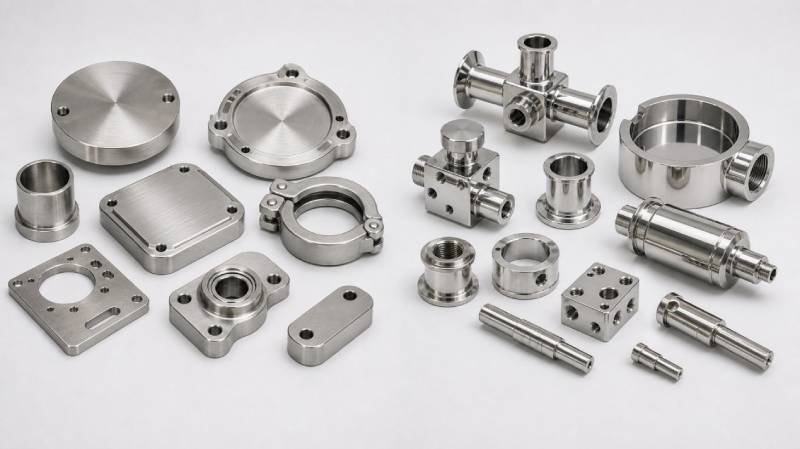
What Is Stainless Steel Passivation?
Passivation is a chemical treatment used to remove free iron, machining residues, and surface contaminants from stainless steel parts.
During CNC machining, stainless steel components may come into contact with cutting tools, fixtures, abrasives, grinding equipment, and other materials that can introduce iron particles or contaminants onto the surface.
These contaminants can reduce corrosion resistance and increase the risk of localized rust.
Passivation chemically cleans the stainless steel surface and helps promote the formation of a stable chromium-rich passive oxide layer.
Unlike plating, painting, or powder coating, passivation does not add a coating to the surface.
The process is commonly performed after:
CNC milling
CNC turning
Drilling
Tapping
Grinding
Deburring
Bead blasting
Mechanical polishing
Welding
Final cleaning
For many precision stainless steel CNC parts, passivation is a practical and cost-effective finishing process when the primary requirement is improved corrosion resistance.
What Is Electropolishing?
Electropolishing is an electrochemical surface finishing process that removes a controlled, microscopic layer of material from the stainless steel surface.
The process preferentially removes microscopic peaks and surface irregularities, helping create a smoother, cleaner, and brighter surface.
Compared with passivation, electropolishing can provide additional surface improvements, including:
Reduced surface roughness
Improved cleanability
Reduced microscopic burrs
Brighter surface appearance
Lower contamination risk
Improved corrosion resistance
Better performance in fluid-contact applications
Electropolishing is commonly used for precision stainless steel components in industries such as:
Medical equipment
Food processing
Pharmaceutical equipment
Semiconductor equipment
Chemical processing
Laboratory equipment
Fluid handling systems
Valves and pumps
When surface cleanliness, smoothness, and contamination control are critical, electropolishing is often preferred over standard passivation.
Passivation vs Electropolishing: Quick Comparison
| Factor | Passivation | Electropolishing |
|---|---|---|
| Main Purpose | Remove free iron and surface contamination | Remove microscopic surface material and improve smoothness |
| Corrosion Resistance | Improved | Improved, often with better overall surface condition |
| Surface Roughness | Minimal improvement | Can reduce microscopic surface roughness |
| Appearance | Little visual change | Brighter and smoother appearance |
| Material Removal | Minimal | Removes a thin surface layer |
| Dimensional Impact | Very small | Must be considered for precision features |
| Micro-Burr Reduction | Limited | Better |
| Cleanability | Improved surface cleanliness | Higher cleanability |
| Cost | Lower | Higher |
| Best Applications | General industrial CNC parts | Medical, food, pharmaceutical, semiconductor, and fluid-contact parts |
The most important difference is that passivation mainly cleans and chemically treats the stainless steel surface, while electropolishing physically removes a microscopic layer of material.
Which Stainless Steel Grades Can Be Passivated or Electropolished?
Both processes are commonly used for CNC machined stainless steel parts.
Typical materials include:
304 stainless steel
316 stainless steel
316L stainless steel
303 stainless steel
17-4PH stainless steel
Other corrosion-resistant stainless steel alloys
304 Stainless Steel
304 stainless steel is widely used for general industrial components, equipment parts, brackets, housings, and food-processing applications.
Both passivation and electropolishing can be used depending on corrosion resistance, appearance, and cleanliness requirements.
316 and 316L Stainless Steel
316 and 316L stainless steel are particularly common for passivated and electropolished CNC parts.
Typical applications include:
Medical components
Pharmaceutical equipment
Marine parts
Chemical processing equipment
Food-processing components
Valves
Pumps
Fluid-contact fittings
For highly corrosive or cleanliness-critical environments, material selection may be just as important as the finishing process.
17-4PH Stainless Steel
17-4PH stainless steel can also be passivated or electropolished.
However, the correct process should be selected according to:
Heat treatment condition
Required mechanical properties
Corrosion resistance requirements
Surface requirements
Final application
When Should You Choose Passivation?
Passivation is recommended when a stainless steel CNC machined part requires improved corrosion resistance but does not need a bright or highly smooth surface.
Choose passivation when:
Corrosion resistance is the primary requirement
The part may contain machining contamination
Minimal dimensional change is required
The part has tight tolerances
A polished appearance is not necessary
Cost control is important
The engineering drawing specifies passivation
The component is used in general industrial environments
Typical applications include:
Stainless steel brackets
Sensor housings
Valve components
Pump parts
Equipment covers
Marine components
Food-processing equipment parts
Chemical equipment components
Bead-blasted stainless steel parts
For many general-purpose stainless steel CNC parts, passivation provides sufficient surface protection without the additional cost of electropolishing.
When Should You Choose Electropolishing?
Electropolishing is recommended when stainless steel parts require higher surface cleanliness, improved smoothness, or a brighter appearance.
Choose electropolishing when:
High cleanability is required
Lower surface roughness is important
A bright or semi-bright finish is needed
Microscopic burr reduction is required
The component contacts fluids or chemicals
Contamination control is important
The part is used in hygienic equipment
The drawing specifically requires electropolishing
Typical applications include:
Medical device components
Surgical instrument parts
Pharmaceutical equipment
Food-processing equipment
Semiconductor equipment components
Fluid-contact fittings
Stainless steel valves
Pump components
Laboratory equipment
Precision nozzles
Electropolishing is generally the better option when the surface condition directly affects product performance, cleanliness, or contamination risk.
Passivation vs Electropolishing for Corrosion Resistance
Both passivation and electropolishing can improve the corrosion resistance of stainless steel, but they work differently.
Passivation removes free iron and surface contaminants that may interfere with the natural corrosion resistance of stainless steel.
Electropolishing removes a microscopic layer from the surface, reducing surface irregularities and contaminants while producing a smoother surface.
For general corrosion resistance after CNC machining, passivation is often sufficient.
For more demanding applications involving medical equipment, pharmaceutical processing, food production, chemicals, or fluid systems, electropolishing may provide additional surface performance benefits.
However, surface treatment cannot compensate for incorrect material selection.
For example, choosing 316 or 316L stainless steel instead of 304 may be more important in highly corrosive environments than simply changing from passivation to electropolishing.
Surface Roughness: Passivation vs Electropolishing
Surface roughness is another important difference between these two processes.
Passivation generally does not significantly change surface roughness.
It can clean the surface but will not remove:
Deep scratches
Machining marks
Tool paths
Dents
Major surface defects
Electropolishing removes microscopic surface peaks and can improve surface smoothness.
However, electropolishing should not be considered a repair process for poor machining quality.
It cannot completely remove deep scratches, severe tool marks, dents, or major surface defects.
If a highly smooth or cosmetic surface is required, mechanical polishing may be necessary before electropolishing.
Dimensional Tolerance Considerations
Dimensional accuracy is particularly important for precision CNC machined parts.
Passivation and Tolerances
Passivation normally has minimal effect on part dimensions because it does not add a coating and removes little measurable material under normal processing conditions.
For this reason, passivation is generally suitable for parts with:
Tight tolerances
Precision holes
Threads
Locating features
Mating surfaces
Electropolishing and Tolerances
Electropolishing removes a thin layer of material from exposed surfaces.
Potential dimensional effects include:
Slight dimensional changes
Edge rounding
Hole size changes
Thread profile changes
Changes to sharp features
Surface smoothing
For precision stainless steel CNC parts, critical dimensions should be reviewed before electropolishing.
The drawing should clearly specify whether dimensional tolerances apply before or after the finishing process.
How Do Passivation and Electropolishing Affect Threads and Holes?
Passivation is generally safer for precision threads, small holes, and sharp features because the process causes minimal material removal.
Electropolishing requires more careful process control.
Features that may require additional consideration include:
Precision threads
Small-diameter holes
Sealing surfaces
Bearing surfaces
Sharp edges
Locating features
Critical mating surfaces
Depending on the application, masking or special process controls may be necessary.
Buyers should clearly identify critical features on the 2D engineering drawing.
Passivation After Bead Blasting
Bead blasting is commonly used to create a uniform matte surface on stainless steel CNC parts.
A typical manufacturing process is:
CNC machining → deburring → bead blasting → cleaning → passivation → final inspection
Passivation after bead blasting may be recommended when corrosion resistance is important because surface contamination or blasting residues may remain after the blasting process.
This process combination is commonly used for stainless steel parts in:
Food-processing equipment
Medical equipment
Marine applications
Chemical equipment
Industrial machinery
The blasting media, surface roughness requirements, cosmetic standards, and passivation specifications should be confirmed before production.
Electropolishing After Mechanical Polishing
Mechanical polishing and electropolishing are sometimes used together when a smooth, clean, and visually attractive stainless steel surface is required.
A typical process is:
CNC machining → deburring → mechanical polishing → cleaning → electropolishing → final inspection
Mechanical polishing improves the visible surface and removes larger surface imperfections.
Electropolishing then improves the microscopic surface condition and cleanability.
This combination is commonly used for:
Medical equipment
Pharmaceutical equipment
Food-processing machinery
Fluid-contact components
High-cleanliness stainless steel parts
Passivation vs Electropolishing Cost
Passivation is generally less expensive than electropolishing.
For many stainless steel CNC machined parts, passivation is sufficient to remove surface contamination and improve corrosion resistance after machining.
Electropolishing typically costs more because:
The process is more complex
Specialized equipment is required
Process control is more demanding
Surface preparation requirements may be higher
Additional inspection may be required
However, the lowest-cost finishing process is not always the correct choice.
Do not specify electropolishing simply because it is considered a more advanced finishing process.
If the part only requires general corrosion resistance, passivation may provide the required performance at a lower cost.
Conversely, do not choose passivation when the application requires high cleanability, lower surface roughness, microscopic burr reduction, or contamination control.
The finishing process should be selected according to the functional requirements of the component.
Common Passivation and Electropolishing Standards
For industrial and precision CNC machined stainless steel parts, customers may specify recognized standards on engineering drawings or purchase orders.
Common passivation standards include:
ASTM A967
ASTM A380
AMS 2700
Depending on the application and industry, additional electropolishing specifications, surface roughness requirements, corrosion tests, or cleanliness standards may also apply.
For medical, aerospace, food, pharmaceutical, semiconductor, or other regulated applications, buyers should provide the exact standard, inspection criteria, testing requirements, and documentation requirements before production.
How Should Buyers Specify Surface Finish Requirements?
To avoid manufacturing misunderstandings, buyers should provide complete surface finishing requirements with the RFQ, engineering drawing, or purchase order.
Important information includes:
Stainless steel grade
Required finishing process
Applicable industry standard
Required surface roughness
Cosmetic requirements
Critical dimensions
Thread requirements
Critical holes
Sealing surfaces
Areas requiring masking
Cleanliness requirements
Corrosion testing requirements
Packaging requirements
Application environment
Inspection requirements
Certification and documentation requirements
For precision CNC parts, simply writing “passivation” or “electropolishing” on the drawing may not provide enough information for demanding applications.
The more complete the technical requirements, the easier it is for the CNC machining supplier to select the correct manufacturing and finishing process.
How to Choose Between Passivation and Electropolishing
Choose passivation when:
The primary requirement is corrosion resistance
The part may contain machining contamination
Minimal dimensional change is required
The part has tight tolerances
A bright or smooth surface is not necessary
Production cost is important
The component is used in general industrial applications
Choose electropolishing when:
Higher surface cleanliness is required
Better cleanability is important
Lower surface roughness is required
A brighter surface is needed
Microscopic burr reduction is important
The component contacts fluids, food, chemicals, or medical media
The application requires improved contamination control
The customer accepts higher finishing costs
The correct process should be selected according to the material, part geometry, tolerance requirements, surface specifications, application environment, and production budget.
Frequently Asked Questions
Is electropolishing better than passivation?
Not necessarily.
Electropolishing provides a smoother, cleaner, and brighter surface, but it is also more expensive and removes a thin layer of material.
For general corrosion resistance after CNC machining, passivation is often sufficient.
Does passivation remove machining marks?
No.
Passivation removes free iron and surface contamination but does not significantly remove scratches, tool marks, or machining lines.
Mechanical polishing or another surface preparation process may be required.
Does electropolishing improve surface roughness?
Yes, electropolishing can reduce microscopic surface peaks and improve surface smoothness.
However, the final result depends on the original surface condition, material, geometry, and process parameters.
Can electropolishing affect CNC machining tolerances?
Yes.
Because electropolishing removes material, it may affect precision holes, threads, sharp edges, sealing surfaces, and other tight-tolerance features.
Critical dimensions should be reviewed before production.
Can stainless steel parts be bead blasted and passivated?
Yes.
A common process is:
CNC machining → deburring → bead blasting → cleaning → passivation
This combination provides a matte appearance while helping improve corrosion resistance.
Which process is better for 316L stainless steel?
The correct process depends on the application.
Passivation is suitable when the primary requirement is corrosion resistance.
Electropolishing may be preferred for medical, pharmaceutical, food-processing, semiconductor, and fluid-contact applications requiring higher cleanliness and smoother surfaces.
Is passivation cheaper than electropolishing?
Generally, yes.
Passivation is usually simpler and more cost-effective, while electropolishing requires more specialized processing and control.
Conclusion
Passivation and electropolishing are both widely used for stainless steel CNC machined parts, but they solve different manufacturing problems.
Passivation is the practical and cost-effective choice when the main objective is to remove machining contamination and improve corrosion resistance with minimal dimensional impact.
Electropolishing is more suitable when the component requires improved surface smoothness, cleanability, appearance, microscopic burr reduction, or contamination control.
For many general industrial stainless steel CNC parts, passivation is sufficient.
For medical, food-processing, pharmaceutical, semiconductor, chemical, and fluid-contact components, electropolishing may provide better overall surface performance.
If you are unsure whether passivation or electropolishing is suitable for your stainless steel CNC parts, send us your 2D drawings, 3D models, material grade, tolerance requirements, surface finish specifications, and application environment.
Our engineering team can review your project and recommend the appropriate CNC machining and surface finishing process before production.