

304 vs 316 Stainless Steel for CNC Machining: Which Material Should You Choose?
Choosing the right stainless steel is an important step when designing and manufacturing CNC machined parts. Among the many stainless steel grades available, 304 and 316 are two of the most commonly used materials for precision components, industrial machinery, automation equipment, food processing systems, medical equipment, pumps, valves, and general mechanical parts.
Both 304 and 316 stainless steel can be CNC milled, turned, drilled, tapped, ground, polished, brushed, bead blasted, electropolished, and passivated.
However, these two materials are not always interchangeable.
304 stainless steel is a practical and cost-effective choice for general industrial components requiring good corrosion resistance. In comparison, 316 stainless steel contains molybdenum, which provides improved resistance to pitting and crevice corrosion in many chloride-containing and demanding environments.
Choosing the wrong stainless steel grade may increase manufacturing costs, reduce component service life, or result in insufficient corrosion resistance for the final application.
In this guide, we compare 304 vs 316 stainless steel for CNC machining, including their material properties, corrosion resistance, machinability, surface finishing options, costs, and typical applications, to help you select the right material for your CNC machined parts.
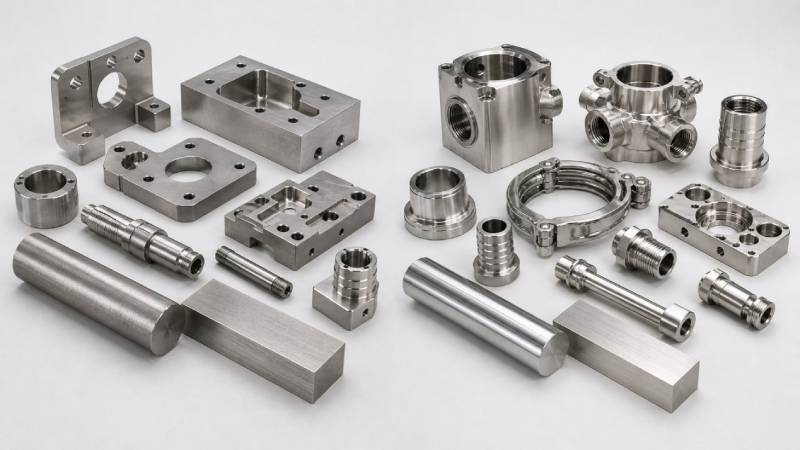
What Is 304 Stainless Steel?
304 is one of the most widely used austenitic stainless steels.
It offers a practical combination of corrosion resistance, formability, weldability, surface finishing capability, material availability, and cost efficiency.
For many general-purpose CNC machined stainless steel components, 304 provides sufficient corrosion resistance and mechanical performance.
It is widely used in industrial machinery, automation equipment, brackets, covers, housings, fixtures, food processing equipment, and general stainless steel components.
Typical Applications of 304 Stainless Steel
304 stainless steel is commonly used for:
Machine brackets
Stainless steel covers
Equipment housings
Automation equipment components
Fixture components
Sensor brackets
Food processing equipment parts
Instrument components
Indoor mechanical parts
General CNC machined stainless steel parts
Decorative components
Brushed stainless steel parts
304 is generally a suitable choice when a component requires good general corrosion resistance, clean appearance, reliable performance, and reasonable manufacturing cost.
What Is 316 Stainless Steel?
316 is also an austenitic stainless steel, but its chemical composition includes molybdenum.
The addition of molybdenum improves resistance to pitting and crevice corrosion in many chloride-containing environments compared with 304 stainless steel.
Because of this characteristic, 316 is commonly selected for components used in marine, chemical, humid, and other demanding environments.
It is also widely used for food processing equipment, medical equipment, pumps, valves, fluid handling systems, and precision components requiring improved corrosion resistance.
Typical Applications of 316 Stainless Steel
316 stainless steel is commonly used for:
Marine components
Chemical processing equipment
Food processing equipment
Medical equipment components
Valve components
Pump components
Fluid handling parts
Sensor housings
Outdoor mechanical components
Precision instrument parts
Components exposed to moisture
Parts requiring improved corrosion resistance
316 is generally selected when corrosion resistance is more important than minimizing raw material cost.
304 vs 316 Stainless Steel: Key Differences
The primary difference between 304 and 316 stainless steel is corrosion resistance.
304 provides good corrosion resistance for many general industrial, indoor, food processing, and mildly corrosive environments.
316 contains molybdenum, which improves resistance to localized corrosion in many chloride-containing and demanding service environments.
However, this does not mean that 316 is automatically the better material for every CNC machining project.
For general machine components, automation equipment, brackets, covers, housings, fixtures, and indoor applications, 304 is often sufficient.
For components exposed to salt, chlorides, certain chemicals, moisture, or more demanding corrosion conditions, 316 may provide better long-term performance.
The correct material choice depends on the actual operating environment, mechanical requirements, surface finishing specifications, component geometry, and manufacturing budget.
304 vs 316 Stainless Steel Properties Comparison
The following table provides a general comparison between 304 and 316 stainless steel.
| Property | 304 Stainless Steel | 316 Stainless Steel |
|---|---|---|
| Stainless Steel Type | Austenitic | Austenitic |
| Primary Advantage | Cost and General Corrosion Resistance | Improved Corrosion Resistance |
| Molybdenum Content | Typically None | Typically 2–3% |
| Mechanical Strength | Moderate | Moderate |
| Corrosion Resistance | Good | Better in Many Demanding Environments |
| Chloride Resistance | Moderate | Better |
| Pitting Resistance | Moderate | Better |
| Machinability | Moderate | Moderate to More Difficult |
| Weldability | Good | Good |
| Formability | Excellent | Excellent |
| Passivation | Yes | Yes |
| Polishing | Excellent | Excellent |
| Electropolishing | Yes | Yes |
| Relative Material Cost | Lower | Higher |
| Typical Applications | General Industrial Parts | More Corrosive Environments |
The exact mechanical and corrosion properties of both materials depend on the applicable material standard, product form, surface condition, manufacturing process, and service environment.
Chemical Composition of 304 vs 316 Stainless Steel
The most important chemical difference between 304 and 316 stainless steel is the addition of molybdenum in 316.
Both materials primarily contain chromium and nickel.
However, 316 typically contains approximately 2–3% molybdenum.
This additional alloying element improves corrosion resistance, particularly resistance to pitting and crevice corrosion in many chloride-containing environments.
This is the primary reason why 316 is often selected for more demanding environmental conditions.
Why Does Molybdenum Matter?
Molybdenum helps improve the stability of the protective passive layer on stainless steel surfaces.
This can provide better resistance to localized corrosion under certain operating conditions.
However, material performance should always be evaluated according to the actual environment.
Factors such as temperature, chloride concentration, chemical exposure, surface condition, cleaning procedures, and component design can all affect corrosion performance.
CNC Machining 304 Stainless Steel
304 stainless steel can be successfully processed using a wide range of CNC machining operations.
Common processes include:
CNC milling
CNC turning
Drilling
Tapping
Boring
Reaming
Precision grinding
However, 304 stainless steel is not as easy to machine as aluminum, free-machining steel, or some carbon steels.
One of the primary machining challenges is work hardening.
If cutting tools rub against the material instead of maintaining an effective cutting action, the local material surface may become harder, increasing cutting forces and accelerating tool wear.
Important Considerations When Machining 304 Stainless Steel
Successful CNC machining of 304 requires careful control of:
Cutting speed
Feed rate
Tool geometry
Tool sharpness
Coolant application
Chip evacuation
Workholding stability
Heat generation
Burr formation
Stable machining parameters and appropriate cutting tools are important for maintaining dimensional accuracy, surface quality, and production efficiency.
CNC Machining 316 Stainless Steel
316 stainless steel can also be CNC milled, turned, drilled, tapped, bored, reamed, and ground.
Its machining characteristics are generally similar to 304.
However, 316 may be more challenging to machine under certain conditions because of its material composition, toughness, and tendency to work harden.
Effective CNC machining of 316 requires proper process control.
Important Considerations When Machining 316 Stainless Steel
Key machining factors include:
Sharp cutting tools
Suitable cutting parameters
Consistent feed rates
Effective coolant application
Good chip evacuation
Stable workholding
Tool wear monitoring
Burr control
For complex or tight-tolerance 316 components, machining sequence and process stability are particularly important.
304 vs 316 Stainless Steel Machinability
Both 304 and 316 can be successfully CNC machined, but neither is considered a free-machining stainless steel.
The two materials can:
Generate significant cutting heat
Cause tool wear
Produce difficult chips
Develop burrs
Work harden during improper machining
Require effective coolant and process control
In many CNC machining applications, 304 may be somewhat easier and more economical to process than 316.
However, the actual difference in machining cost depends heavily on:
Component geometry
Material condition
Cutting tools
Machine rigidity
Cutting parameters
Dimensional tolerances
Surface finish requirements
Production quantity
For high-precision stainless steel parts, selecting the correct machining strategy is often more important than the small difference in machinability between 304 and 316.
304 vs 316 Corrosion Resistance
Corrosion resistance is the most important factor when choosing between 304 and 316 stainless steel.
Corrosion Resistance of 304 Stainless Steel
304 provides good corrosion resistance for many applications, including:
General industrial environments
Indoor machinery
Automation equipment
Food processing equipment
Kitchen equipment
Equipment housings
Mildly corrosive environments
For many standard CNC machined stainless steel parts, 304 provides sufficient corrosion resistance at a lower material cost.
Corrosion Resistance of 316 Stainless Steel
316 provides improved corrosion resistance compared with 304 in many demanding environments.
It is commonly considered for components exposed to:
Chlorides
Salt-containing environments
Certain chemicals
High humidity
Marine atmospheres
Fluid handling systems
Aggressive cleaning processes
However, 316 is not completely corrosion-proof.
Actual corrosion performance depends on factors such as:
Temperature
Chloride concentration
Chemical concentration
Surface condition
Crevice geometry
Cleaning procedures
Operating environment
For critical applications, material selection should be based on the actual service conditions rather than simply choosing the higher-grade stainless steel.
Is 316 Stainless Steel Better Than 304 for Marine Applications?
316 is generally preferred over 304 for many marine and chloride-containing environments because of its improved resistance to pitting and crevice corrosion.
However, the term “marine environment” covers a wide range of service conditions.
A component exposed occasionally to coastal air does not experience the same corrosion conditions as a component continuously submerged in seawater.
For demanding marine applications, engineers should consider:
Chloride concentration
Exposure time
Temperature
Component geometry
Crevices
Surface finish
Cleaning and maintenance
316 may provide better performance than 304, but more corrosion-resistant materials may still be required for severe applications.
Surface Finishing Options for 304 and 316 Stainless Steel
Both 304 and 316 can receive a wide range of surface finishing processes.
Common finishing options include:
Passivation
Mechanical polishing
Brushing
Bead blasting
Electropolishing
Precision grinding
Pickling
Cleaning
Laser marking
The correct finishing process depends on the component application, cosmetic requirements, corrosion environment, surface roughness specifications, and cleanliness requirements.
Passivation of 304 and 316 Stainless Steel
Passivation is commonly used for CNC machined stainless steel parts.
The process helps remove free iron and contaminants from the surface while supporting the formation of the natural passive oxide layer.
Both 304 and 316 can be passivated after CNC machining.
Passivation may be particularly important for components used in:
Medical equipment
Food processing equipment
Chemical systems
Fluid handling systems
Corrosive environments
The correct passivation specification should be determined according to the component application and customer requirements.
304 vs 316 Stainless Steel Cost
304 stainless steel is generally more cost-effective than 316.
The higher cost of 316 is primarily associated with its alloy composition and improved corrosion performance.
However, raw material price is only one part of the total manufacturing cost.
The final cost of a CNC machined stainless steel component depends on:
Raw material price
Component geometry
Machining time
Tool consumption
Dimensional tolerances
Surface roughness requirements
Surface treatment
Inspection requirements
Production quantity
Choosing 316 for a general indoor component may unnecessarily increase material cost.
However, choosing 304 for a component exposed to demanding corrosive conditions may increase the risk of corrosion, premature component failure, maintenance costs, and replacement expenses.
The correct material should provide sufficient performance without unnecessary over-specification.
When Should You Choose 304 Stainless Steel?
Choose 304 stainless steel when:
The component is used in a general industrial environment
Cost control is important
General corrosion resistance is sufficient
The component is primarily used indoors
The part is a bracket, cover, housing, fixture, or machine component
The component is not exposed to demanding chloride conditions
A clean stainless steel appearance is required
The part requires polishing, brushing, or passivation
For many general-purpose CNC machined stainless steel components, 304 provides a practical balance between corrosion resistance, manufacturing capability, availability, and cost.
When Should You Choose 316 Stainless Steel?
Choose 316 stainless steel when:
Improved corrosion resistance is required
The component is exposed to chlorides
The part operates in a humid or demanding environment
The component is used in certain chemical processing applications
The part is used in fluid handling equipment
The component is used in pumps or valves
The application requires better resistance to pitting and crevice corrosion
Long-term corrosion performance is more important than minimizing raw material cost
316 is particularly suitable when the service environment requires better corrosion resistance than standard 304 stainless steel can provide.
304 or 316: Which Stainless Steel Is Better for CNC Machining?
There is no single answer because the correct material depends on the application.
For general CNC machined stainless steel parts, brackets, covers, housings, fixtures, and automation equipment components, 304 stainless steel is often sufficient.
For CNC machined components exposed to chlorides, salt, moisture, certain chemicals, or more demanding corrosion conditions, 316 stainless steel may be the better choice.
A simple selection rule is:
Choose 304 when general corrosion resistance and cost efficiency are the primary requirements.
Choose 316 when improved corrosion resistance is more important than minimizing material cost.
Frequently Asked Questions About 304 vs 316 Stainless Steel
Is 316 Stainless Steel Better Than 304?
Not always.
316 provides better corrosion resistance than 304 in many demanding and chloride-containing environments.
However, 304 is more cost-effective and provides sufficient performance for many general industrial applications.
The better material depends on the component application and operating environment.
Is 316 Stainless Steel Stronger Than 304?
The mechanical strength of 304 and 316 is generally similar, although exact properties depend on the material specification, product form, and condition.
The primary advantage of 316 over 304 is improved corrosion resistance rather than significantly higher mechanical strength.
Which Is Easier to Machine: 304 or 316?
Both materials can be challenging to machine because of work hardening, cutting heat, chip control, and tool wear.
304 may be somewhat easier and more economical to machine in many applications.
However, actual machining performance depends heavily on cutting tools, parameters, machine rigidity, component geometry, and tolerance requirements.
Is 316 More Corrosion Resistant Than 304?
Generally, yes.
The molybdenum content of 316 improves resistance to pitting and crevice corrosion in many chloride-containing and demanding environments.
Can 304 and 316 Stainless Steel Be Passivated?
Yes.
Both 304 and 316 can be passivated after CNC machining.
Passivation helps remove surface contamination and supports the natural passive oxide layer of the stainless steel.
Which Stainless Steel Is Better for Food Processing Equipment?
Both 304 and 316 are widely used in food processing applications.
The correct material depends on factors such as food composition, cleaning chemicals, temperature, chloride exposure, hygiene requirements, and applicable industry standards.
316 may be preferred in more demanding corrosive environments, while 304 is widely used for general food processing equipment.
Which Stainless Steel Is Better for Medical Components?
Both 304 and 316 stainless steels can be used in medical equipment applications.
The correct material depends on the specific component, sterilization process, corrosion environment, surface requirements, and applicable regulatory standards.
316L is frequently considered for demanding medical applications requiring improved corrosion resistance.
Which Stainless Steel Is Better for Marine Applications?
316 is generally preferred over 304 for many marine environments because of its improved resistance to chloride-induced corrosion.
However, actual material selection should consider the severity of the marine environment and the specific operating conditions.
Is 316 Stainless Steel Worth the Higher Cost?
It depends on the application.
If a component is used in a general indoor environment, the additional cost of 316 may not provide meaningful benefits.
If the component is exposed to chlorides, salt, moisture, or more aggressive corrosion conditions, the improved corrosion resistance of 316 may justify the higher cost.
304 vs 316 vs 17-4PH: Which Stainless Steel Should You Choose?
304, 316, and 17-4PH stainless steels are designed for different engineering requirements.
Choose 304 for general-purpose CNC machined stainless steel parts where good corrosion resistance and cost efficiency are important.
Choose 316 for CNC machined components requiring improved corrosion resistance in more demanding environments.
Choose 17-4PH for high-strength mechanical components requiring increased hardness and heat-treatment capability.
If mechanical strength and hardness are the primary requirements, 17-4PH may be more suitable than either 304 or 316.
How to Choose the Right Stainless Steel for CNC Machined Parts
Material selection should not be based only on raw material price or stainless steel grade.
Before selecting between 304 and 316, engineers should evaluate:
Component geometry
Operating environment
Chloride exposure
Chemical exposure
Temperature
Mechanical loads
Dimensional tolerances
Surface roughness requirements
Surface treatment
Cleaning requirements
Production quantity
Manufacturing budget
For complex or demanding CNC machined components, reviewing these requirements before production can help reduce manufacturing risks, control costs, and improve long-term component performance.
Conclusion
304 and 316 are both widely used stainless steels for CNC machining, but they are suitable for different operating environments and engineering requirements.
304 stainless steel is a practical and cost-effective material for general industrial components, brackets, covers, housings, fixtures, and automation equipment parts.
316 stainless steel is generally more suitable for components requiring improved corrosion resistance, particularly in chloride-containing, humid, chemical, and other demanding environments.
The correct material choice depends on the component design, operating environment, corrosion exposure, dimensional tolerances, surface finishing requirements, and manufacturing budget.
If you are unsure whether 304 or 316 stainless steel is suitable for your CNC machined parts, send us your 2D drawings, 3D models, material specifications, tolerance requirements, surface treatment requirements, and application details.
The CUSTPARTS engineering team can review your project requirements and help recommend a suitable stainless steel material and CNC machining solution before production.