How to Reduce CNC Machining Costs
CNC (Computer Numerical Control) machining is a cornerstone of modern manufacturing, offering high precision and repeatability. However, controlling costs can be a significant challenge, especially for complex parts or low-volume production. Understanding the factors that drive costs and implementing smart design and manufacturing strategies can lead to substantial savings without compromising quality.
This article will explore key strategies to help you lower your CNC machining costs.
1. Simplify Part Design
The most impactful cost-saving measure often starts at the design phase. Complex geometries, tight tolerances, and intricate features can drastically increase machining time and tooling requirements.
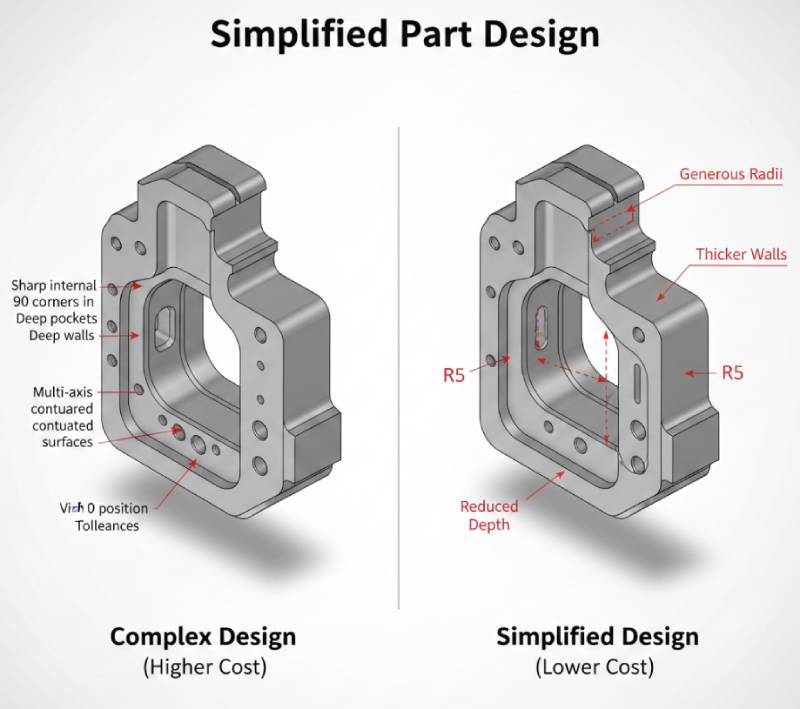
Avoid Unnecessary Features: Every additional feature, pocket, or curve adds complexity. Evaluate if each design element is truly critical to the part's function. Can a rounded corner replace a sharp one? Can a complex contour be simplified into a series of straight lines and arcs?
Use Standard Radii: When designing internal corners, opt for standard tool radii. For example, if you design a corner with a 3.175mm (1/8 inch) radius, the machinist can use a standard 6.35mm (1/4 inch) end mill. Non-standard radii might require custom tooling or more passes, adding time and cost.
Reduce Part Count: If possible, integrate multiple small parts into a single, more complex (but still manufacturable) CNC machined component. This can save on assembly costs and inventory.
Illustrative Image: A side-by-side comparison of a complex, difficult-to-machine part vs. a simplified, cost-effective version of the same part. Highlight the differences (e.g., sharp internal corners vs. generous radii, deep pockets vs. shallower ones).`
2. Optimize Tolerances and Surface Finishes
Tighter tolerances and smoother surface finishes demand more precise machining, slower feed rates, specialized tools, and often, more inspection time – all of which increase costs.
Specify Only Necessary Tolerances: Apply tight tolerances only to critical features that directly impact the part's function or assembly. Leave non-critical dimensions with standard, looser tolerances. A general tolerance of ±0.1mm (±0.004 inches) is often sufficient and much cheaper than ±0.01mm (±0.0004 inches).
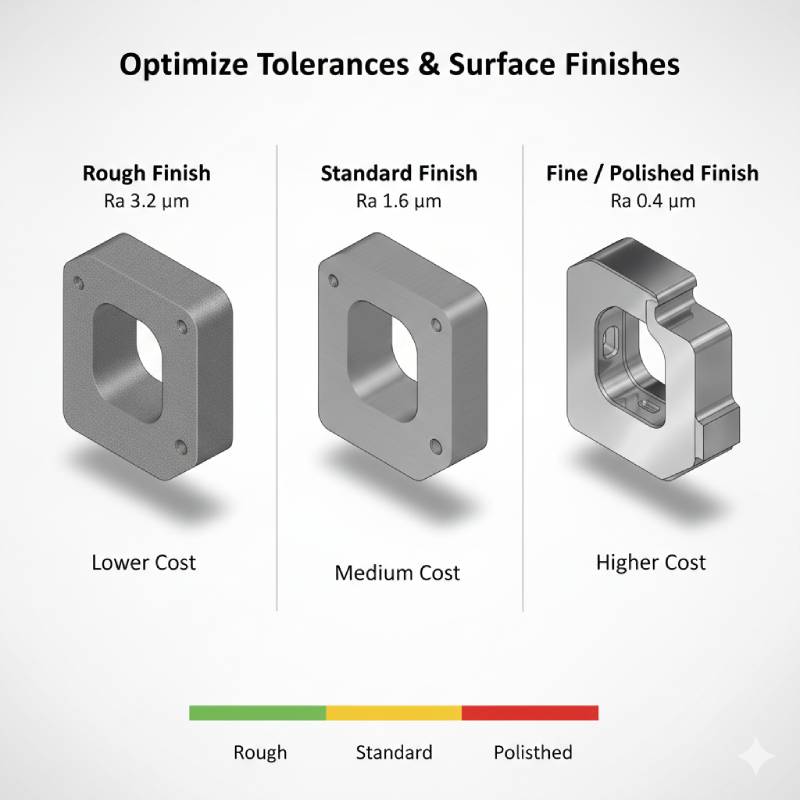
Choose Appropriate Surface Finishes: Mirror-like finishes (e.g., Ra 0.4 µm) require extra polishing or grinding steps. If a rougher finish (e.g., Ra 3.2 µm) is acceptable for the application, specify it to avoid unnecessary finishing operations.
Illustrative Image: A diagram showing different surface finishes with their corresponding Ra values and associated cost implications (e.g., a "rough" texture with low cost, a "standard" texture with medium cost, and a "polished" texture with high cost).`
Select Cost-Effective MaterialsMaterial choice significantly impacts machining costs, not only due to the raw material price but also because of machinability. Harder, more abrasive, or specialized materials are more challenging to cut, wear out tools faster, and require slower machining speeds.
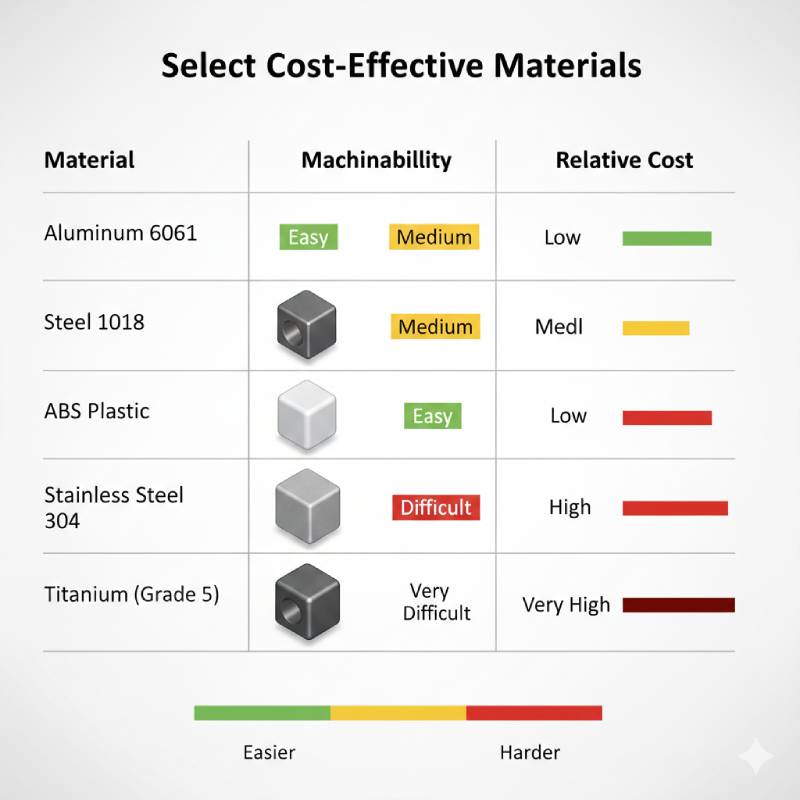
Consider Common Alloys: Standard aluminum alloys (e.g., 6061), mild steels (e.g., 1018), and common plastics (e.g., ABS, Delrin) are generally easier and cheaper to machine.
Evaluate Alternatives: If a specific high-performance material isn't absolutely critical, research if a more machinable, lower-cost alternative could meet the application's requirements. For instance, can 303 stainless steel be used instead of 304 or 316 if corrosion resistance is less critical? 303 is much more machinable.
Material Availability: Rare or specialty materials might have longer lead times and higher procurement costs, especially for smaller quantities.
Illustrative Image: A chart or infographic comparing different common CNC materials (e.g., Aluminum 6061, Steel 1018, ABS, Stainless Steel 304, Titanium) with their relative machinability (e.g., easy, medium, difficult) and general cost range.`
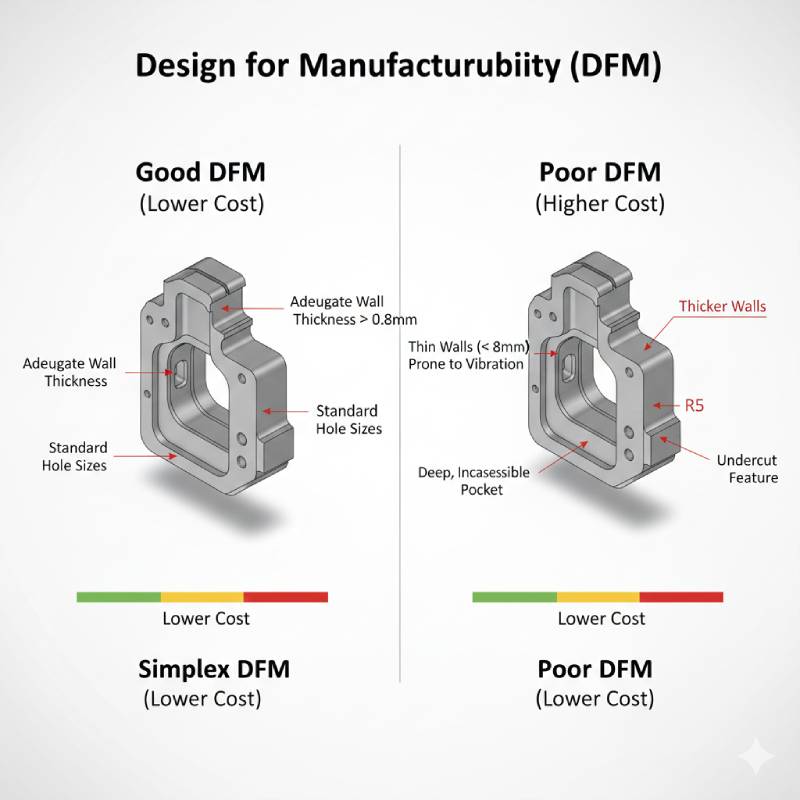
Design for Manufacturability (DFM)DFM is the practice of designing products in a way that makes them easy to manufacture. For CNC, this means considering the machining process during design.
Standard Features: Use standard hole sizes, tap sizes, and feature depths that can be made with off-the-shelf tools.
Accessible Features: Ensure that cutting tools can easily reach all features without requiring specialized long-reach tools or multiple setups. Deep, narrow pockets or holes are more difficult and expensive to machine.
Avoid Undercuts when Possible: While CNC machines can create undercuts, they often require specialized tools or multi-axis machining, which adds cost. If possible, design parts to avoid them.
Wall Thickness: Maintain adequate wall thickness. Thin walls are prone to vibration and deformation during machining, requiring slower speeds and multiple passes, leading to higher costs. A general rule of thumb is at least 0.8mm (0.03 inches) for most metals.
Illustrative Image: A CAD drawing or render of a part showing good DFM principles (e.g., adequate wall thickness, accessible features, standard hole sizes) contrasted with a poorly designed part (thin walls, deep inaccessible pockets).`
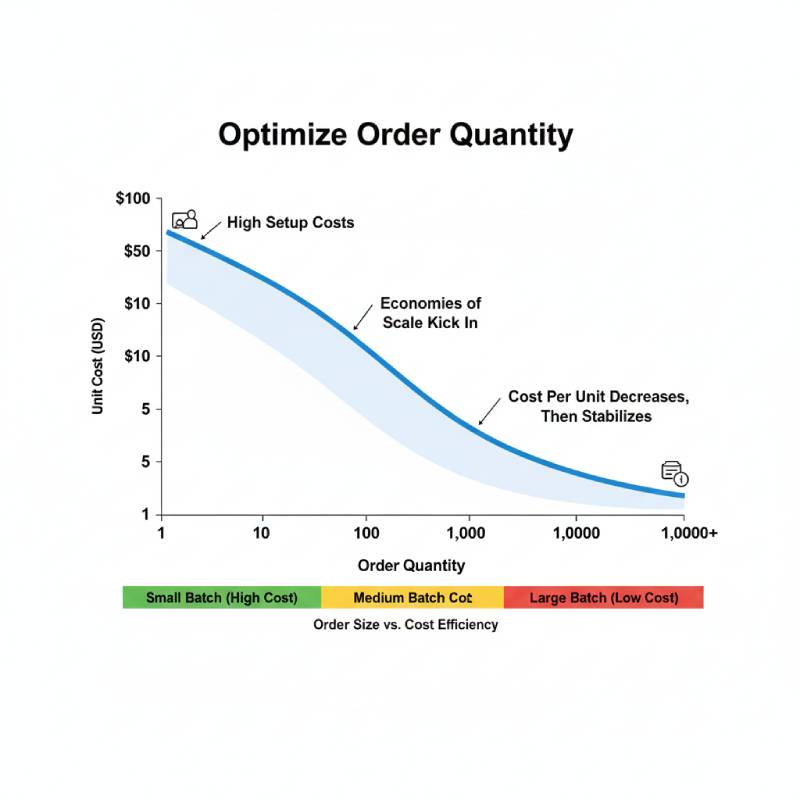
Optimize Order QuantityThe unit cost of CNC machined parts often decreases with higher order volumes due to economies of scale.
Setup Costs: Every CNC job involves setup time (programming, fixturing, tool changes). These fixed costs are spread over more parts in larger orders, reducing the per-unit cost.
Material Utilization: Larger batches can lead to more efficient use of raw material stock, minimizing waste.
Negotiate with Suppliers: For ongoing projects or repeat orders, discuss potential discounts with your CNC machining service provider based on volume.
Illustrative Image: A graph showing the relationship between order quantity and unit cost – demonstrating that as quantity increases, the unit cost decreases significantly initially, then flattens out.`